
California Landlord Tenant Laws 2024: The Definitive Compliance Guide for 2026

What if the systems you've used to manage your rentals for years are now your biggest legal liability? The 2024 legislative session wasn't just a minor update to the rulebook. It was a fundamental shift toward a new era where systemized compliance is the only way to protect your investment. Mastering the california landlord tenant laws 2024 is no longer just about staying informed; it's about survival in a market defined by strict "just cause" eviction rules and new limits on security deposits.
It's completely understandable if you feel overwhelmed by the conflicting local rent caps in cities like Sacramento or the complex requirements of SB 567. You aren't alone in wondering how to balance these state mandates with local ordinances. This guide will help you master these legislative changes so you can maintain compliance and avoid costly legal errors in 2026. We'll walk through a clear checklist of current requirements, explain the new one-month security deposit caps, and clarify how your eviction rights have evolved under the latest standards. By the end, you'll have the steady hand needed to manage your properties with total confidence.
Key Takeaways
Understand how the expansion of "just cause" eviction requirements under SB 567 fundamentally changes your legal obligations and burden of proof as an owner.
Learn how to navigate the california landlord tenant laws 2024 regarding security deposit caps, which now limit most deposits to just one month's rent regardless of furniture.
Identify the specific documentation and permit requirements you must provide to tenants before initiating a "no-fault" eviction for substantial property remodeling.
Simplify your administrative workflow by utilizing new options for electronic screening fee receipts while ensuring your fees stay within the annual CPI-adjusted limits.
Discover why professional management systems are now essential for maintaining compliance in a landscape where local ordinances often exceed statewide standards.
Table of Contents
The 2024 Legislative Shift: Why California Rental Laws Changed Forever
The 2024 legislative session was a turning point for property owners across the state, fundamentally reimagining the california landlord tenant laws 2024 to prioritize tenant stability. Legislators focused on closing specific gaps in the Tenant Protection Act of 2019, moving the industry toward a high-accountability model. This shift wasn't just about adding a few new rules; it was a targeted effort to ensure that the protections established years ago were actually being followed. If you've felt that the management process is becoming more rigid, you're right. The 2024 Compliance Era represents a permanent move from optional management styles to mandatory, systemized reporting where every action must be documented.
This new legal environment means that being a "casual" landlord is no longer a viable strategy. You need to understand how the state views the Landlord-tenant law framework to avoid accidental non-compliance. In the Sacramento region, these state rules often intersect with even stricter local ordinances, such as Measure Q, which creates a much lower rent ceiling for older buildings than the state baseline allows. Managing your properties now requires a "boots-on-the-ground" familiarity with how these layers of law overlap.
The Evolution of the Tenant Protection Act (AB 1482)
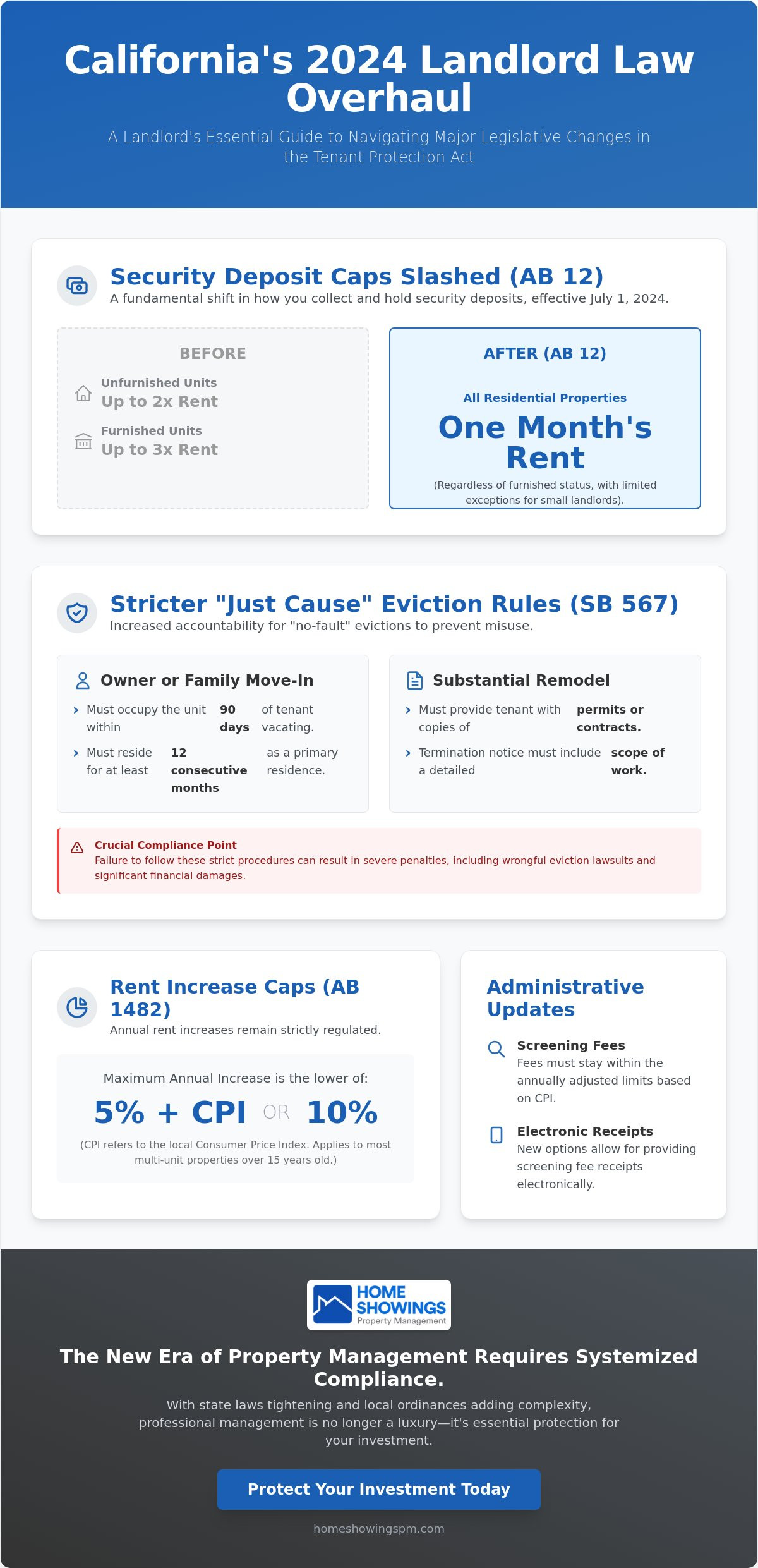
While AB 1482 has been the baseline for years, the 2024 updates clarified exactly which properties fall under state control. Most multi-unit properties built more than 15 years ago are firmly covered. If you own a single-family home or condo, you might be exempt, but only if the property isn't owned by a corporation and you've provided specific legal notice to your tenants. The rent cap mechanism remains a primary focus; you're limited to an increase of 5% plus the local Consumer Price Index, with an absolute ceiling of 10% in any 12-month period. These reforms specifically targeted "no-fault" evictions, which state officials believed were being used by some to bypass rent caps and clear units without legitimate cause.
The Role of SB 567 in Closing Loopholes
SB 567 significantly tightened the rules around "just cause" evictions, particularly regarding owner move-ins. In the past, the intent to move in was sometimes used as a way to end a tenancy without a clear follow-through. Under the current california landlord tenant laws 2024, if you or a direct family member plan to move into a unit, you must occupy the property within 90 days of the tenant vacating. You're also required to live there for at least 12 consecutive months. Failing to meet these strict timelines can result in severe penalties, including lawsuits for wrongful eviction and significant financial damages. This law ensures that every "no-fault" reason is backed by genuine, documented action.
Security Deposit Caps: Navigating the AB 12 Mandate
The landscape of california landlord tenant laws 2024 shifted significantly on July 1, 2024, when Assembly Bill 12 officially took effect. This law fundamentally changed how you collect and hold security deposits, removing the old tiered system that many owners relied on for decades. If you've traditionally used a larger deposit to buffer against potential damage or unpaid rent, you're now operating under a much tighter limit. For any lease active or signed in 2026, the state has capped security deposits at a maximum of one month's rent. This is a massive departure from previous years, and it requires a more meticulous approach to how you vet applicants and maintain your property.
While the law isn't retroactive for deposits collected before the effective date, any new lease or renewal signed after July 2024 must strictly adhere to these caps. If you're currently holding a deposit that exceeds the new limit for a long-term tenant, you don't necessarily have to refund the difference immediately, but you must ensure all new agreements are compliant. This change is part of the broader California Tenant Protection Act framework designed to lower the barrier to entry for renters across the state.
Furnished vs. Unfurnished: The New Uniformity
Under the old rules, you could charge up to two months' rent for unfurnished units and three months for furnished ones. That distinction is gone. The one-month cap now applies regardless of the furniture provided. This change has led some owners to explore "disguised deposits," such as significantly increased pet rent or high non-refundable fees. Be careful with these tactics. Courts often view any upfront payment intended to cover damage as a security deposit, regardless of the label you use. To protect your investment without the cushion of a high deposit, you must prioritize high-quality tenant screening. If you're worried about the reduced financial safety net, our property management services can help you implement rigorous oversight that prevents issues before they start.
The Small Landlord Exception Criteria
There is a narrow exception for "small landlords" within the california landlord tenant laws 2024. You may still charge up to two months' rent if you are a natural person or an LLC where all members are natural persons. To qualify, you must own no more than two residential rental properties that collectively contain no more than four units. It's vital to document your eligibility for this exception clearly. If your property is held in a corporation or a larger investment trust, you're strictly bound by the one-month rule. Claiming this exception without proper legal standing can expose you to significant liability if a tenant challenges the deposit amount in court.
Stricter Eviction Procedures and Just-Cause Requirements
Terminating a tenancy has always been a sensitive process; however, the california landlord tenant laws 2024 have turned what used to be a standard procedure into a high-stakes legal exercise. The state's primary goal with recent reforms was to eliminate "bad faith" evictions where owners used loopholes to clear out units. If you're moving forward with a no-fault eviction today, you must be prepared to provide a much higher level of documentation than in years past. Mistakes aren't just inconvenient; they can lead to statutory damages and mandatory tenant reinstatement. To stay on the right side of the law, it's helpful to review a detailed walkthrough of the eviction process for California landlords before taking any formal action.
One of the most significant changes involves the "substantial remodel" provision. In the past, some owners used the promise of renovations to terminate leases without a clear plan. Now, if you issue a notice for a substantial remodel, you're legally required to include a detailed description of the work and copies of the necessary permits. The work must also be significant enough that it requires the tenant to vacate for at least 30 days. If the permits aren't in hand when the notice is served, the eviction is considered invalid from the start. This requirement serves as a safeguard, ensuring that "just cause" remains the standard for every property transition.
Owner Move-In and Relative Occupancy Rules
The 2024 updates via SB 567 introduced strict timelines for owners or their relatives who intend to occupy a rental unit. If you're reclaiming a property for personal use, you or your qualifying family member must move into the unit within 90 days of the tenant vacating. Once you move in, you're required to use the property as your primary residence for at least 12 consecutive months. If these conditions aren't met, the law assumes the eviction was performed in bad faith. This can trigger heavy penalties, and you may be forced to offer the unit back to the displaced tenant at the original rent price.
Withdrawal of Property from the Rental Market
If you decide to exit the rental business entirely under the Ellis Act, the 2024 standards require meticulous record-keeping. Withdrawing a property from the market is a permanent move that requires notifying the local government and the tenants well in advance. A critical piece of this process is the "Right of First Refusal." If you decide to put the property back on the rental market within five to ten years of the withdrawal, you must typically offer the unit to the previous tenant first. Maintaining organized digital records of all communications and filings is the only way to prove compliance if your motives are ever questioned years down the road.
Operational Compliance: Screening Fees, Receipts, and Disclosures
Administrative tasks often feel like a burden, but the california landlord tenant laws 2024 actually introduced some welcome flexibility for modern owners. AB 1765 is a prime example of this shift toward efficiency. It finally allows you to deliver screening fee receipts via email, provided the applicant agrees to digital delivery. This move away from mandatory paper trails aligns with the digital-first approach required in today's rental market. While the delivery process is now simpler, the costs remain strictly regulated. The maximum allowable screening fee is adjusted annually based on the Consumer Price Index (CPI). You'll need to verify the current CPI-adjusted limit for 2026 before you process any new applications to ensure you aren't overcharging.
Beyond fees, your disclosure obligations remain a critical compliance pillar that can't be overlooked. You're still legally required to provide clear, written disclosures regarding flood zones and bed bug history for every new tenancy. These aren't just suggestions; they're mandatory components of a valid lease agreement. Failing to include these disclosures can create significant legal vulnerabilities if a dispute arises later. It's about transparency and protecting both parties by setting clear expectations from day one.
Modernizing the Application Process
Establishing a systemized workflow is the best way to handle these recurring requirements without letting details slip through the cracks. Automated receipts and digital time-stamping protect you by creating an immutable record of every interaction with a prospective tenant. This level of precision is a hallmark of the Sacramento property management models that utilize advanced owner and tenant portals. When every disclosure and receipt is logged automatically, you don't have to worry about missing a deadline or losing a paper trail in a filing cabinet.
Protecting Vacant Assets with SB 602
Vacancy periods can be stressful, but SB 602 provides a much-needed shield for your investment. This law extended the validity of "Trespass Letters" (often called 602 letters) from a mere 30 days to a full 12 months. By filing this letter with the Sacramento or Elk Grove police departments, you authorize law enforcement to remove trespassers from your vacant property without you being physically present. It's a vital tool for preventing squatter issues in a climate where property rights are closely scrutinized. Managing these filings across a portfolio requires a proactive approach to ensure no asset is left unprotected during a transition. If you're ready to move toward a more secure, systemized way of managing your rentals, our team at Home Showings Property Management can implement these operational safeguards for you.
Ensuring Compliance in Sacramento: The Value of Professional Systems
Attempting DIY management in California has become a high-liability endeavor that many owners simply can't afford. The california landlord tenant laws 2024 have created an environment where a single administrative oversight can lead to a five-figure legal bill. If you're still managing your properties with spreadsheets and paper files, you're at a significant disadvantage compared to the professional systems now required by state and local courts. Professional management isn't just a service cost; it's a fundamental protection of your real estate asset against the rising tide of regulatory complexity.
In regions like Folsom and Roseville, where the market is competitive and tenant expectations are high, having a "local expert" in your corner is essential. We treat your property with the meticulousness it deserves, ensuring that every legislative shift is accounted for before it becomes a problem. This proactive stance is what separates a successful investment from a source of constant legal anxiety. By leveraging a tech-savvy approach, we automate the heavy lifting of compliance so you can focus on your long-term financial goals.
Automated Rent Caps and Financial Reporting
Our owner portals take the guesswork out of financial compliance by tracking local CPI changes in real-time. This ensures that every rent increase stays within the legal limits of AB 1482 or stricter local measures like Sacramento's Measure Q. These digital records are also your first line of defense against "wrongful eviction" claims, providing a clear audit trail of all communications. Our system also handles complex scenarios seamlessly, such as what happens if a tenant breaks a lease. We ensure that the mitigation of damages and the return of security deposits follow the specific 2024 standards without exception, protecting you from claims of bad faith.
Proactive Maintenance and Inspections
Maintaining a "boots-on-the-ground" presence in Elk Grove and the surrounding areas allows us to document property conditions with precision. We use regular inspections to create a clear distinction between "normal wear and tear" and actual damage, which is vital now that security deposits are capped at one month's rent. This documentation also supports SB 567 compliance by proving the necessity of substantial remodels when a unit must be vacated. If you want to ensure your investment is fully protected under the california landlord tenant laws 2024, it's time to professionalize your approach. Contact us today at Home Showings Property Management to schedule a comprehensive compliance audit for your Sacramento rental property and gain the peace of mind that comes with expert oversight.
Securing Your Rental Future in the New Regulatory Era
The transition into 2026 requires more than just awareness; it demands a proactive management strategy. You've seen how the california landlord tenant laws 2024 fundamentally reshaped everything from security deposit limits to the burden of proof required for no-fault evictions. By moving away from manual processes and toward systemized oversight, you eliminate the guesswork that leads to costly legal disputes. Whether it's documenting substantial remodels or automating screening fee receipts, every detail now serves as a vital safeguard for your real estate investment.
If the complexity of these overlapping state and local rules feels like a heavy burden, you don't have to carry it alone. Our team serves as your local experts in Sacramento, Elk Grove, and Roseville, providing the "boots-on-the-ground" presence you need. We combine comprehensive screening and maintenance systems with tech-forward owner and tenant portals to ensure your portfolio remains resilient and profitable. Protect your investment with a 2026 Compliance Audit from Home Showings Property Management. With a steady hand and the right tools, you can navigate this new era of property ownership with total confidence and peace of mind.
Frequently Asked Questions
How much can a landlord charge for a security deposit in California in 2026?
In 2026, you can generally charge a maximum of one month's rent for a security deposit. This uniform limit applies to both furnished and unfurnished units under the california landlord tenant laws 2024. If you qualify as a "small landlord" by owning no more than two residential properties with a total of four units or fewer, you may still charge up to two months' rent.
What are the new "Just Cause" eviction rules under SB 567?
SB 567 significantly increased the burden of proof for no-fault evictions. If you're evicting for a substantial remodel, you must provide the tenant with copies of valid permits and a detailed description of the work. For owner move-ins, the notice must include the name and relationship of the person moving in, and they must occupy the unit for at least 12 months.
Can I still evict a tenant in California to move into my own house?
Yes, you can still evict a tenant to move into your own house, but you must follow strict new timelines. You or your qualifying family member must move into the property within 90 days of the tenant vacating. Failure to occupy the unit as your primary residence for at least 12 consecutive months can lead to severe bad-faith penalties and lawsuits.
Is there a limit on how much I can increase rent in Sacramento County?
Rent increases in Sacramento County are generally capped at 5% plus the local Consumer Price Index, with an absolute maximum of 10%. However, if your property is within the City of Sacramento and was built before February 1, 1995, Measure Q imposes a much stricter limit. In those cases, the increase is capped at the lower of 3% or 60% of the CPI.
Do the 2024 security deposit caps apply to existing tenants or only new leases?
The 2024 security deposit caps apply to new leases and renewals signed on or after July 1, 2024. If you're managing a tenancy that began before this date, you aren't required to refund the excess deposit immediately. You must ensure that any new agreement or lease renewal signed in 2026 stays within the one-month limit to maintain compliance.
What is the maximum tenant screening fee allowed in California for 2026?
The maximum tenant screening fee is adjusted annually based on the Consumer Price Index. For 2026, you should verify the specific dollar amount, which typically ranges between $50 and $65 per applicant. Staying within this limit is a core requirement of the california landlord tenant laws 2024, and you must provide a receipt for the fee, which can now be delivered via email.
What happens if I accidentally charge more than one month’s rent for a deposit?
Charging more than the legal limit can result in statutory damages of up to twice the amount of the security deposit. If you discover an overcharge, it's best to refund the excess amount to the tenant immediately and document the correction. This proactive step shows good faith and helps protect you from potential legal claims regarding non-compliance.
How does the 2024 "Trespass Letter" law help landlords with vacant properties?
The updated "Trespass Letter" law, SB 602, allows you to file a 12-month authorization with local police departments like Sacramento or Elk Grove. This letter gives law enforcement the authority to remove unauthorized individuals from your vacant property without you being present. It's an essential tool for preventing squatter issues and protecting your asset during periods of vacancy.


Comments