
What Happens If You Break a Lease? A California Landlord-Tenant Guide for 2026

Breaking your lease in California doesn't automatically mean you're on the hook for every single month of remaining rent. Many tenants assume that signing a year-long agreement creates an unbreakable financial debt, but the reality is often much more flexible. If you face a sudden job transfer or family emergency while tied to a rental agreement, it's natural to feel overwhelmed. You might worry about losing your security deposit or facing a lawsuit that ruins your credit. Understanding exactly what happens if you break a lease is the first step toward managing the situation with confidence instead of fear.
We understand that life moves fast, and sometimes your housing needs to move with it. In this guide, we'll break down the legal and financial consequences of early termination under California’s latest 2026 tenant laws. You will learn about the landlord's mandatory duty to mitigate damages by finding a new tenant and how updated habitability standards might provide a legal exit. We will also cover practical steps to minimize your liability and keep your rental history clean. From security deposit electronic returns to new disaster-related protections, we have organized everything you need to transition smoothly to your next chapter.
Key Takeaways
Learn the legal distinction between breaking a fixed-term lease and terminating a month-to-month agreement to avoid unnecessary legal complications.
Understand what happens if you break a lease in terms of financial liability and how California's mitigation laws prevent landlords from collecting double rent.
Identify the specific legal scenarios, such as active military service or habitability issues, that permit you to end your tenancy without penalty.
Discover how to use early termination clauses and digital tenant portals to create a professional paper trail that protects your credit and security deposit.
Table of Contents
The Legal Framework: What It Means to Break a Lease in California
A lease agreement is much more than a simple list of house rules; it is a foundational financial contract. To understand The Legal Framework of a Lease, you have to view it as a mutual promise. When you sign a fixed-term agreement, you are committing to pay a specific amount of rent over a set period, which is typically one year. If you move out before that date, you are technically breaking the contract. This is a distinct legal action compared to terminating a lease, which usually refers to ending a month-to-month agreement with proper notice or letting a fixed term expire naturally. When you ask what happens if you break a lease, you are essentially asking how the law handles a breach of that financial promise.
California law generally views a tenant’s remaining rent as a debt owed to the landlord. However, residential leases in areas like Sacramento are treated differently than commercial contracts. In a residential setting, the law balances the landlord's right to rent with the tenant's need for mobility. This means that while you are technically liable for the remaining months, there are built-in protections that prevent a landlord from simply collecting a windfall of cash without trying to find a replacement.
Fixed-Term vs. Periodic Tenancies
The weight of your legal obligation depends heavily on the structure of your tenancy. A 12-month lease offers the most stability, but it is also the hardest to walk away from without a plan. In California, these leases often automatically convert into month-to-month periodic tenancies once the initial year is up. If you are in a month-to-month arrangement, you can typically leave by providing 30 days of written notice. For Sacramento residents, following these notice requirements is vital to avoid being charged for an extra month of rent. A fixed-term lease does not offer this same "notice and leave" flexibility, meaning you are tied to the property until the end date unless you reach a separate agreement with the owner.
California Civil Code Basics
The governing statute for these situations is California Civil Code § 1951.2, which sets the ground rules for how landlords can recover lost rent. This law is designed to be fair; it ensures the landlord is made whole but doesn't allow for excessive penalties. Under California law, lease abandonment occurs when a tenant clearly demonstrates an intent to permanently vacate the premises and stops paying rent without a legal reason to do so. Your specific lease agreement, such as those used by Home Showings, will often contain clauses that explain how to handle this process professionally. By reviewing these terms early, you can better understand what happens if you break a lease and take proactive steps to protect your rental history and your wallet.
The Real-World Consequences: Financial and Credit Impacts
Moving out before your lease ends creates a ripple effect that touches both your bank account and your long-term reputation as a renter. If you decide to vacate early, your primary financial obligation is the rent for the remaining months of the contract. However, you aren't necessarily paying for an empty apartment for a year. California law requires landlords to try and find a replacement, meaning your liability ends the moment a new qualified tenant moves in. According to California's official landlord-tenant guidelines, you remain responsible for the rent during that transition period, along with any costs associated with preparing the unit for a new occupant.
Your security deposit is often the first line of defense for a landlord facing a broken lease. While usually reserved for cleaning and repairs, these funds can also be legally applied to unpaid rent. Landlords have exactly 21 days after you move out to return the deposit or provide an itemized statement of deductions. If the total debt from lost rent and turnover costs exceeds your deposit, the landlord may pursue the balance through the Sacramento County Small Claims Court. This isn't just a minor inconvenience; a court order to pay can lead to wage garnishments or bank levies. This is why it's so important to understand exactly what happens if you break a lease before you turn in your keys.
How Lease Breaking Affects Your Credit Score
If a balance remains unpaid, the debt often moves from the landlord's ledger to a collection agency. Once this happens, the agency reports the delinquency to major credit bureaus, which can cause your score to drop significantly. Unlike a simple late credit card payment, a rental debt often results in a "judgment" if the case goes to court. This public record is a major red flag for property managers in Roseville or Folsom. When they run a background check, a history of lease-breaking makes you appear as a high-risk applicant, often leading to denied applications or requirements for much higher security deposits in the future.
The Cost of Re-Leasing Fees
Many tenants are surprised to find "reletting fees" in their contracts. In California, these fees must represent the actual costs of finding a new tenant rather than serving as a flat penalty. You might be responsible for marketing expenses, such as professional photography or premium listing placements, to attract a replacement quickly. Utilizing professional property management in Sacramento helps ensure these costs are calculated fairly and transparently. If you're feeling stuck, reaching out to a local property expert can help you navigate these fees without unnecessary stress.
Legally Justifiable Reasons to Break a Lease Without Penalty
If you find yourself in a situation where the law is on your side, you can walk away from your rental agreement without the financial burdens we discussed earlier. California provides specific "safety valves" that protect tenants facing extraordinary circumstances. While most people worry about what happens if you break a lease, those who qualify for legal exemptions can often terminate their tenancy with minimal notice and zero penalties. These protections are designed to prioritize human safety and basic living standards over a standard housing contract.
Active military service members have the strongest protections under the federal Servicemembers Civil Relief Act (SCRA). If you receive orders for a permanent change of station or a deployment lasting more than 90 days, you can terminate your lease by providing written notice and a copy of your orders. Your tenancy will typically end 30 days after the next rent payment is due. This ensures that those serving our country aren't penalized for the unpredictable nature of military life.
Health and Safety: Habitability Standards
Every residential lease in California carries an "implied warranty of habitability," meaning the property must be fit for human occupation. In the Sacramento region, a unit is legally uninhabitable if it lacks essential features like effective weatherproofing, plumbing, or heat. As of January 1, 2026, this definition has expanded under AB 628 to include the requirement for a functional stove and refrigerator. If your landlord fails to maintain these basics after receiving written notice, you may have the right to move out under "constructive eviction." You should always document the issues with photos and keep a log of your repair requests before claiming this remedy, as a court will look for proof that the landlord had a reasonable chance to fix the problem.
Domestic Violence and Safety Protections
Safety is a non-negotiable right for every tenant. Under California Civil Code § 1946.7, survivors of domestic violence, sexual assault, stalking, or elder abuse can break their lease with just 14 days of notice. To use this protection, you must provide documentation such as a police report or a court-issued restraining order. The law is very clear here: the landlord cannot withhold your security deposit solely because you are using this legal exit. This protection is a vital lifeline that allows individuals to prioritize their physical safety without the fear of a ruined credit score or a lawsuit for future rent. If you're navigating this sensitive process, having a clear digital paper trail through a secure portal can help ensure your privacy and legal compliance are maintained throughout the transition.
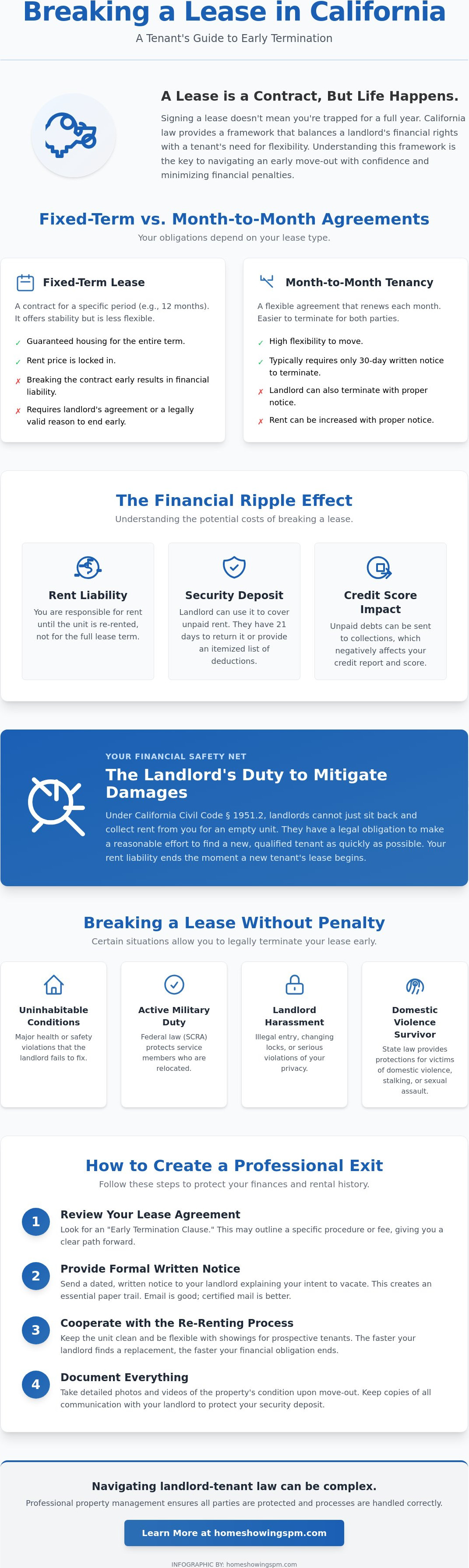
The Landlord’s Duty to Mitigate Damages: Your Financial Safety Net
One of the most significant protections you have as a California tenant is the landlord’s legal obligation to "mitigate damages." This means that if you move out early, the property owner cannot simply leave the unit empty and send you a bill for the remaining months of the lease. They are legally required to make a good-faith effort to re-rent the space as quickly as possible. In a competitive market like Elk Grove, this usually involves active advertising and prompt showings to prospective renters. Understanding this rule is essential when figuring out what happens if you break a lease, as it often drastically reduces your total financial liability.
The current market conditions in the Sacramento region play a major role in how quickly you can walk away from your rent payments. With the rental vacancy rate in California sitting at approximately 4.80% as of early 2025, demand for quality housing remains steady. If the property is priced correctly and in good condition, a landlord should be able to find a replacement within a reasonable timeframe. Your financial responsibility for the rent stops the moment a new qualified tenant signs a lease and takes over the unit. This creates a natural limit on your liability that is based on market speed rather than just the number of months left on your contract.
California Civil Code § 1951.2 Explained
Mitigation of damages is the legal requirement for a landlord to take reasonable steps to find a replacement tenant and minimize the financial loss resulting from a breached lease agreement. This statute places the burden of proof on the landlord. If they want to hold you responsible for lost rent, they must demonstrate that they actively marketed the property at a fair market rate. Utilizing professional rental marketing services in Sacramento is a common way landlords meet this requirement; it ensures the vacancy is seen by the widest possible audience. If a landlord fails to show they tried to fill the vacancy, a court may rule that you don't owe for the time the property sat empty.
How You Can Help Speed Up the Process
While the legal burden is on the landlord, your cooperation is your best financial strategy. If you provide flexible times for prospective renters to view the home while you are still moving out, you increase the chances of finding a replacement before your official departure date. Keeping the property in "show-ready" condition is equally important. A clean, well-maintained home attracts better applicants and helps the unit lease faster, which directly protects your wallet. Even if you find a friend interested in taking over, they must still pass the same professional tenant screening process as any other applicant to ensure the landlord's investment remains protected. If you are looking for a team that prioritizes low vacancy and high-quality placements, consider working with our rental marketing and management experts to ensure a smooth transition.
A Professional Exit: How to Break Your Lease the Right Way
If you've determined that you must leave your rental early, the way you handle the departure determines the long-term impact on your rental history. While the previous sections covered the legalities of what happens if you break a lease, this final step focuses on protecting your reputation and your security deposit through clear communication. Your first move should always be to review your contract for specific "early termination" or "buy-out" clauses. Some agreements allow you to pay a flat fee, often equal to two months of rent, to end the contract immediately without further obligation. If your lease includes this option, it's often the cleanest way to move on without worrying about how long it takes to find a new tenant.
Negotiating a "surrender of possession" agreement is another powerful tool for a professional exit. This document officially records the date you return the keys and the landlord accepts the unit back. It serves as a final boundary for your financial liability. Without this, a landlord might argue that you haven't technically vacated, which could lead to additional rent charges. By formalizing the hand-off, you ensure that both parties are on the same page regarding the end of the tenancy. This proactive approach ensures that when you look back at what happens if you break a lease, you see a managed process rather than a legal nightmare.
Communication and Documentation Strategy
Relying on verbal agreements with an on-site manager is a common mistake that leads to expensive disputes. If you don't have it in writing, it didn't happen. We recommend using the Home Showings tenant portal to track every message, from your initial notice to the final scheduling of your walkthrough. This creates a time-stamped digital paper trail that protects you if questions arise later. When you draft your "Notice of Intent to Vacate," be sure to mention your awareness of the landlord's duty to mitigate damages. This professional approach signals that you understand your rights and are committed to a cooperative transition.
The Final Walkthrough and Security Deposit
California law gives you the right to request a "pre-move-out inspection" during the last two weeks of your tenancy. This is your opportunity to identify any issues the landlord might consider "tenant damage" so you have time to fix them yourself. Remember, you aren't responsible for "normal wear and tear," such as minor scuffs on the walls or carpet fading from sunlight. Once you've moved out and returned the keys, the 21-day clock starts. Under the updated 2026 regulations, landlords must offer to return your deposit electronically if you paid it that way. Finalizing your utility transfers on the day you return the keys is the final step to ensure you aren't billed for services you didn't use. By following these steps, you can turn a stressful situation into a controlled, professional move.
Navigating Your Next Move with Confidence
Understanding the nuances of California law transforms a stressful lease break into a manageable transition. We have explored how the landlord's duty to mitigate damages acts as your financial safety net and why specific legal protections might allow for a penalty-free exit. By prioritizing clear documentation through digital portals and requesting pre-move-out inspections, you protect your credit score and your security deposit. Now that you know exactly what happens if you break a lease, you can make decisions that align with your housing goals and financial health.
Expert knowledge of the California Civil Code is essential for a worry-free rental experience. Our team specializes in the Sacramento and Elk Grove residential markets, offering dedicated Owner and Tenant Portals to keep every detail organized and transparent. Need professional help managing your Sacramento rental? Contact Home Showings Property Management today.
Moving forward doesn't have to be a burden when you have the right local guide by your side.
Frequently Asked Questions
Can I break my lease if I lose my job in Sacramento?
Losing your job is not a legally justifiable reason to break a lease without penalty under California law. While we understand this is a stressful situation, you remain financially responsible for the rent until the landlord finds a replacement tenant. It's best to communicate with your landlord immediately to discuss a potential payment plan or to see if they will agree to a voluntary termination to avoid a negative impact on your credit.
How much notice do I need to give to break a lease in California?
If you are on a month-to-month agreement, you must provide at least 30 days' written notice to terminate your tenancy. For a fixed-term lease, there isn't a specific notice period that automatically clears your debt. However, providing at least 30 days of notice is highly recommended. This allows your landlord enough time to market the property and find a new tenant, which reduces the total amount of rent you'll owe during the vacancy.
Is a 'lease buyout' the same as breaking a lease?
A lease buyout is a pre-negotiated agreement where you pay a specific fee to end your contract early, while breaking a lease is a breach of contract without a prior arrangement. Buyouts provide a clean, professional exit and stop your rent obligations immediately. If your contract doesn't include a buyout clause, you'll face the standard process of what happens if you break a lease, which includes paying rent until a new tenant is screened and moved in.
What happens to my security deposit if I leave early?
Your security deposit can be legally used by the landlord to cover unpaid rent or cleaning and repair costs after you vacate. California law requires the landlord to provide an itemized statement and return any remaining funds within 21 days of your move-out. If you leave the property in show-ready condition and a new tenant is found quickly, you have a much better chance of recovering a portion of your deposit.
Can my landlord sue me for the entire remainder of the lease at once?
No, a landlord cannot sue you for the entire remaining balance of the lease the moment you leave. Because California requires landlords to mitigate damages, they can only sue for the actual rent lost while the unit was vacant. Once a new tenant signs a lease, your liability for future rent ends. If a landlord fails to make a reasonable effort to re-rent the unit, they may lose their right to collect any remaining rent from you.
Does breaking a lease show up on a background check for my next apartment?
Breaking a lease doesn't appear on a standard criminal background check, but it can surface during the tenant screening process if your previous landlord reports a debt. If the unpaid rent is sent to a collection agency, it will appear on your credit report as a significant red flag. Future property managers in the Sacramento region often deny applications if they see a history of rental collections or civil judgments from a previous tenancy.
What if I find a new tenant to take over my lease myself?
Finding a replacement tenant is a great way to speed up the mitigation process, but the landlord must still conduct their own professional tenant screening. You cannot simply assign your lease to someone else without written permission from the owner. If your referral passes the screening and signs a new agreement, your financial responsibility for the rent stops. This is often the fastest way to minimize your liability when you need to move quickly.
Can I break my lease because of noisy neighbors or a bad neighborhood?
Generally, noisy neighbors or general neighborhood concerns are not legal grounds to break a lease without penalty. To walk away without cost, you must typically prove the landlord has failed to provide a habitable environment or has violated your right to quiet enjoyment. If the noise is coming from a source the landlord doesn't control, such as a public street or a neighboring property, you will likely still be responsible for the rent until a new tenant is found.



Comments