
California Tenant Screening Laws: A 2026 Guide for Landlords

If you processed a rental application this morning using last year's checklist, you might have already stepped into a legal minefield without realizing it. Staying current with California tenant screening laws feels like a full-time job, and the 2026 updates have significantly raised the stakes for every property owner. It's completely normal to feel overwhelmed by the transition from old habits to new mandates like mandatory appliance provisions and strict cybersecurity standards for your data vendors. When the rules for processing fees and security deposits change overnight, even the most meticulous landlord can feel a bit unsteady.
You deserve to manage your investment without the constant fear of accidental discrimination lawsuits or processing errors. This guide provides the clarity you need to master the 2026 landscape, ensuring your screening process is both efficient and fully compliant. We'll walk through the updated $65 fee caps, the new electronic deposit return requirements under AB 414, and the specific steps required to protect tenant data. By the end of this article, you'll have a reliable, step-by-step roadmap to secure high-quality tenants while keeping your business protected.
Key Takeaways
Understand the legal definition of screening under Civil Code 1950.6 to ensure your intake process aligns with current california tenant screening laws.
Learn how to calculate the 2026 inflation-adjusted application fee cap and the specific details required for mandatory itemized receipts.
Master the procedural requirements for sharing credit reports and issuing compliant "Adverse Action" notices to avoid costly legal disputes.
Identify the expanded protected classes under California’s Unruh Civil Rights Act that go beyond federal standards to prevent accidental discrimination.
Discover why a "process-first" approach and professional screening tools are essential for managing the high-liability landscape of modern property management.
Table of Contents
The Foundation of California Tenant Screening Laws in 2026
California Civil Code 1950.6 provides the legal bedrock for how you evaluate potential residents. It defines tenant screening as the process of using an application, credit report, or other background data to determine a candidate's eligibility for a rental unit. While it might seem like a routine administrative task, 2026 has brought a sharper focus on how this data is handled. Compliance isn't just about following a checklist; it's about building a robust defense against Fair Housing complaints that can arise from even minor procedural slips.
Understanding the broader context of Landlord-Tenant Law is essential for any property owner. In California, state regulations generally set the floor. If a local ordinance in a city, such as those in various California municipalities including communities within the greater Sacramento area, is stricter, those rules apply. However, for most of the state, these california tenant screening laws provide the definitive standard you must meet. The California Civil Rights Department (CRD) actively monitors these standards, ensuring that every applicant receives a fair and transparent evaluation. If you fail to provide the required disclosures or misuse background information, the CRD has the authority to investigate and levy penalties that can disrupt your entire operation.
Why Compliance Matters for Sacramento Landlords
If you own property in Sacramento or Roseville, you know that local courts are increasingly vigilant about tenant protections. A single non-compliant application denial can lead to significant financial penalties if it's perceived as discriminatory or procedurally flawed. We take a "Tech-Savvy Local Guide" approach to these challenges. By using modern systems to track every step of the screening process, you create a digital paper trail that proves your commitment to fair housing. This proactive oversight turns a potential liability into a position of strength. When you can demonstrate that your criteria are applied consistently to every applicant, you significantly lower your risk profile.
Key Regulatory Bodies and Resources
The Department of Real Estate (DRE) offers guidelines that every landlord should internalize, but the Fair Employment and Housing Act (FEHA) is where the real complexity lies. FEHA dictates how your criteria impact protected classes, making it vital to review your standards annually. Because california tenant screening laws evolve every January, staying ahead of legislative updates is the only way to ensure your portfolio remains protected. Relying on outdated forms or "gut feelings" is no longer a viable strategy. You need a system that integrates:
Current DRE compliance checklists for application handling.
FEHA-aligned screening criteria that avoid disparate impact.
Proactive audits of your application process to catch errors early.
This methodical approach ensures that your rental business stays several steps ahead of potential legal issues. By grounding your practices in these foundational rules, you build a foundation of trust with your tenants and protect your long-term investment.
Navigating Application Fees and AB 2493 Requirements
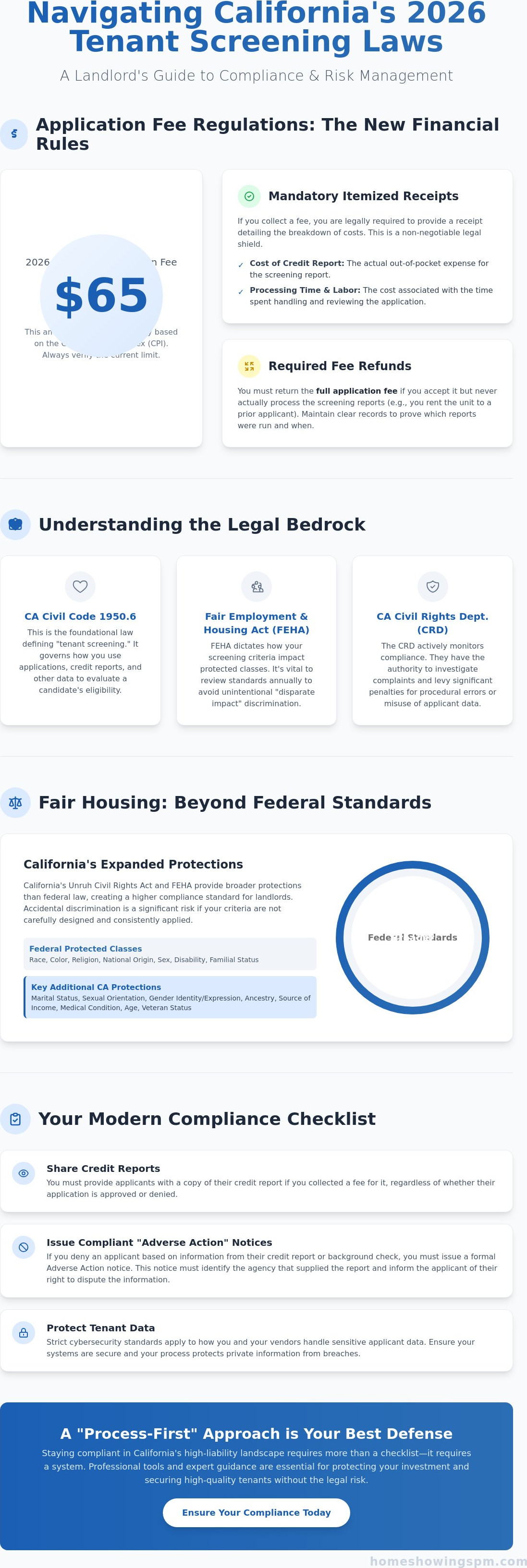
By 2026, managing application fees has moved from a simple transaction to a strictly regulated workflow. Under current california tenant screening laws, the maximum fee you can charge per applicant is capped at approximately $65. This amount is adjusted annually based on the Consumer Price Index, so it's vital to verify the exact limit before your next listing goes live. If you collect a fee, you're legally required to provide an itemized receipt that breaks down the cost of the credit report and the time spent processing the application. This transparency isn't just a courtesy; it's a legal shield that protects you from claims of predatory fee collection.
The law is equally clear about what happens to those funds if you don't actually run the background check. If you accept a fee but never process the application, you must return the full amount to the applicant. This often happens when a previous applicant is approved before you reach the next person in line. To stay compliant with the FTC Guidance on Consumer Reports, ensure your internal documentation clearly shows which reports were pulled and when. If you don't have a system to track these timestamps, you're leaving yourself open to unnecessary risk.
Option A: The First-Come, First-Served Workflow
If you're managing a high-demand rental in Elk Grove, you might receive dozens of applications in a single weekend. The safest path to avoid discrimination claims is a strict first-come, first-served policy. We recommend using a digital platform that automatically timestamps every submission. This creates a transparent, unalterable record of the processing order. If the first applicant qualifies, you must stop and return any unearned fees to the remaining candidates. Communicating clearly with "next-in-line" applicants keeps the process professional and prevents the frustration that often leads to legal disputes.
Option B: Accepting Reusable Tenant Screening Reports
A significant shift in 2026 is the widespread use of reusable tenant screening reports. These portable documents allow tenants to pay a single fee to a third party and share the results with multiple landlords for 30 days. If an applicant provides a verified, comprehensive report that meets California standards, you generally cannot charge them an additional screening fee. You'll need to verify that the report includes all necessary credit and criminal history data. While you can't charge for the report itself, you can still verify the information to ensure it's authentic and hasn't been tampered with.
Managing these shifting requirements doesn't have to be a source of stress. Choosing to work with professional tenant screening experts ensures that your workflows are always up to date with the latest legislative changes. This proactive oversight protects your investment while providing a seamless, compliant experience for your future tenants.
Credit Reports and Criminal History Limitations
Once you've navigated the initial application fees and verified any reusable reports, you enter the most sensitive phase of the process. Modern california tenant screening laws require a high level of transparency when it's time to evaluate an applicant's financial and legal history. You're no longer just looking at a score; you're managing a regulated data exchange. If you use a credit report to make a decision, you're legally obligated to provide a copy of that report to the applicant. This ensures they have the same information you do, allowing them to identify potential errors or identity theft early in the process.
Data security has become a primary focus for state regulators. Starting January 1, 2026, AB 1414 requires landlords to use third-party screening services that meet specific cybersecurity standards. This means you can't just store sensitive documents in an unencrypted folder on your laptop. A "Tech-Savvy Local Guide" approach involves using secure owner and tenant portals to keep this data protected. By utilizing professional systems, you ensure that your vendor's security practices meet the 2026 legal threshold, shielding you from liability if a data breach occurs elsewhere.
Handling Consumer Credit Reports Properly
Privacy is the top priority when handling credit data. If an applicant disputes the information found in their report, you should direct them to the credit bureau, but you must also remain open to hearing their explanation. According to the California Landlord Tenant Laws, procedural errors in this phase are a common source of tenant complaints. If you deny an application or require a higher deposit based on credit data in 2026, you must issue a written Adverse Action notice that includes the contact details of the credit bureau and the specific reasons for your decision. This single document is your most important piece of evidence that you've followed federal and state disclosure rules.
Restrictions on Criminal Background Inquiries
California’s "Fair Chance" rules have fundamentally changed how landlords view criminal history. You can't use blanket "no-felony" policies; these are often seen as discriminatory and can trigger significant legal pushback. Instead, you're required to perform an individualized assessment. This means looking at the nature of the offense, how much time has passed, and what the individual has done since then. It's also vital to distinguish between arrests and convictions. Under california tenant screening laws, you generally cannot deny a tenant based on an arrest that didn't lead to a conviction. By focusing on recent, relevant convictions that directly impact the safety of the property or other residents, you maintain a safe community while staying firmly on the right side of the law.
Fair Housing Compliance and Anti-Discrimination
While credit scores and background checks provide a data-driven view of an applicant, they must be viewed through the lens of fair housing compliance. The Federal Fair Housing Act provides a baseline, but California’s Unruh Civil Rights Act is far more expansive. In our state, california tenant screening laws protect individuals from discrimination based on factors that federal law doesn't always explicitly cover. This includes protection against arbitrary discrimination, which means you can't deny someone simply because you don't like their appearance, lifestyle, or personal affiliations.
One of the most critical mandates for modern landlords is SB 329, which redefined "source of income." You can't refuse an applicant just because they use a Section 8 voucher or other housing assistance. When you calculate income requirements for these applicants, you're legally required to use the tenant’s portion of the rent rather than the total monthly rent amount. For disabled applicants, you must also engage in an interactive process regarding reasonable accommodations during the screening phase. This might involve allowing a service animal in a "no pets" unit or providing application materials in an alternative format to ensure equal access.
Protected Classes in the Golden State
California leads the nation in protecting gender identity, sexual orientation, and marital status. In local markets like Sacramento and Elk Grove, the trend toward stricter "Fair Chance" ordinances means your screening process must be beyond reproach. If you're feeling overwhelmed by these evolving standards, reading our guide on Professional Property Management in Sacramento, CA can help you align your portfolio with 2026 expectations. Staying updated on these local nuances is the only way to avoid the "arbitrary discrimination" trap that often catches DIY owners who rely on outdated criteria.
Avoiding Disparate Impact in Your Criteria
Even if your intentions are good, a "neutral" rule can still be illegal if it disproportionately affects a protected group. This is known as disparate impact. For example, requiring a "permanent full-time job" might seem like a safe way to ensure rent collection, but it could unfairly exclude disabled individuals or retirees who have stable, non-employment income. To protect yourself, you need written, consistent screening criteria that you apply to every single person. When your rules are documented and based on legitimate business needs, you significantly reduce the risk of a fair housing complaint or a costly investigation.
If you want to ensure your rental criteria are fully compliant with the latest state mandates, our professional tenant screening services provide the methodical oversight you need to grow your investment safely.
Staying Compliant: The Value of Professional Screening
Mastering the nuances of california tenant screening laws is a monumental task for a solo property owner. By 2026, the margin for error has essentially vanished. If you miss a single update to fee transparency under AB 747 or fail to provide an itemized receipt within the legal window, you're not just losing a potential tenant. You're potentially facing a lawsuit that could wipe out a year's worth of rental income. It's a high-stakes environment where "doing your best" isn't a valid legal defense in the eyes of the California Civil Rights Department.
Managing properties in Folsom or Rancho Cordova requires a "boots-on-the-ground" understanding of both state and local trends. One of the most overlooked benefits of professional systems is the automated audit trail they provide. If a fair housing complaint ever lands on your desk, your first line of defense is your data. Professional owner and tenant portals create a chronological record of every application, timestamp, and disclosure sent. This level of meticulous organization isn't just about efficiency; it's about providing you with a worry-free experience where every detail is documented before an issue even arises.
Why DIY Screening is Risky in 2026
DIY screening is becoming a liability because it's nearly impossible to keep up with rapid-fire legislative changes while managing daily operations. For instance, the new requirement to ensure screening vendors meet strict cybersecurity standards under AB 1414 adds a layer of technical vetting most owners aren't prepared to handle. Small errors in fee handling or failing to offer electronic deposit returns can lead to massive penalties. Beyond the financial risk, the emotional toll of managing applicant confrontations during individualized assessments is significant. When you're the one delivering a denial, you're the target for frustration that often leads to legal challenges.
How Home Showings Property Management Protects Owners
We take a systematic approach to AB 2493 and Fair Housing compliance to ensure your investment stays profitable and protected. Our process-first mindset means we handle the "Adverse Action" notices, the itemized receipts, and the verification of reusable reports with total precision. By using secure portals for transparent reporting, we protect tenant data while giving you 24/7 access to the status of your rentals. We stay several steps ahead of potential issues so you don't have to. Let us handle your tenant screening in Sacramento and Elk Grove to ensure your property meets every 2026 standard with confidence.
Securing Your Rental Future with Compliance and Confidence
The rental market in 2026 demands more than just a quick credit check; it requires a deep understanding of shifting regulations. We've explored how mastering california tenant screening laws involves everything from managing the $65 fee cap to navigating the complexities of "Fair Chance" background assessments. You've seen that success lies in transparency, from providing itemized receipts to ensuring your vendors meet the latest cybersecurity standards. These steps aren't just hurdles. They're the building blocks of a stable, profitable rental business that respects tenant rights while protecting your bottom line.
If the weight of these legal requirements feels heavy, you don't have to carry it alone. Our team provides meticulous oversight of California rental regulations combined with deep local expertise in Sacramento and Elk Grove. By using our fully compliant digital owner and tenant portals, you gain an automated audit trail that keeps you one step ahead of potential disputes. Protect your investment with professional tenant screening from Home Showings Property Management. You've worked hard to build your portfolio. Let's work together to ensure it stays protected and prosperous for years to come.
Frequently Asked Questions
What is the maximum application fee a landlord can charge in California for 2026?
For 2026, the maximum screening fee is approximately $65 per applicant. This amount is adjusted annually based on the Consumer Price Index to reflect rising costs. You're legally required to provide an itemized receipt for the actual expenses incurred, such as the credit report and the administrative time spent processing the application. If your actual costs are lower than the state cap, you can only charge the lower amount.
Do I have to accept a reusable tenant screening report from an applicant?
You aren't strictly forced to accept every report, but if an applicant provides a verified reusable report that meets California standards, you generally cannot charge them an additional fee. These reports must be comprehensive and generated within the last 30 days. Accepting these portable reports can streamline your workflow and make your property more attractive to cost-conscious applicants while still providing the data you need.
Can I deny a tenant in California based on their criminal record?
You cannot use blanket "no-felony" policies to deny applicants under current california tenant screening laws. Instead, you must conduct an individualized assessment that considers the nature of the offense and the time passed since the conviction. It's also illegal to deny a tenant based on an arrest that didn't lead to a conviction or a record that has been sealed or expunged by the court.
How long do I have to return an application fee if I don’t run the background check?
You must return any unused portion of the application fee within a reasonable timeframe, typically within 7 to 10 days of deciding not to process the application. If you approve a prior applicant before reaching the next person in line, you're legally required to refund the unearned fee. Keeping funds for reports you never pulled is a major compliance risk that can lead to significant penalties and legal disputes.
Am I required to give the tenant a copy of their credit report?
Yes, if the applicant requests it or if you take adverse action based on the report data, you must provide them with a copy. This is a core requirement of California Civil Code 1950.6. Providing this document ensures transparency and allows the applicant to verify the data you used to make your decision. It's a simple step that builds trust and keeps your screening process beyond reproach.
Can I refuse to rent to a tenant with a Section 8 voucher in Sacramento?
No, you cannot refuse an applicant solely because they use a Section 8 voucher or other housing assistance. SB 329 protects "source of income" as a protected class across the state, including Sacramento and Elk Grove. When you're evaluating their income, you must calculate their ability to pay based only on the portion of the rent they're personally responsible for, not the total monthly amount.
What happens if I process applications out of order under AB 2493?
Processing applications out of order significantly increases your risk of fair housing and discrimination claims. AB 2493 emphasizes a transparent, first-come, first-served workflow to ensure every applicant is treated fairly. If you skip a qualified early applicant for a later one without a documented, non-discriminatory reason, you could face legal challenges. Using a digital timestamp system is the best way to prove your processing order.
Is a written screening criteria required by law in California?
While state law focuses heavily on the consistent application of rules, having written screening criteria is the best way to prove compliance with california tenant screening laws. Documenting your standards for income, credit, and rental history allows you to show that every applicant was judged against the same benchmarks. This written record is your strongest defense if your screening decisions are ever questioned by a regulatory body or in court.


Comments