
Which Sacramento neighborhoods offer rental value growth?

Sacramento ranked in the top 10% of U.S. markets for home appreciation over the past 10 years, making long-term value growth an important part of the city’s rental investment story. Sacramento rental property value appreciation can make a neighborhood appealing, but purchase price and rental income also shape the return.
Looking beyond a home’s resale potential makes sense: investors also need to consider whether rent can support the property along the way. This guide compares neighborhood prices and returns, explains factors that influence Sacramento’s market and rental demand, and weighs cash flow against appreciation. You’ll get a clearer framework for assessing how long-term growth may fit your investment goals.
Table of Contents
1. Neighborhood-level investment prices and returns
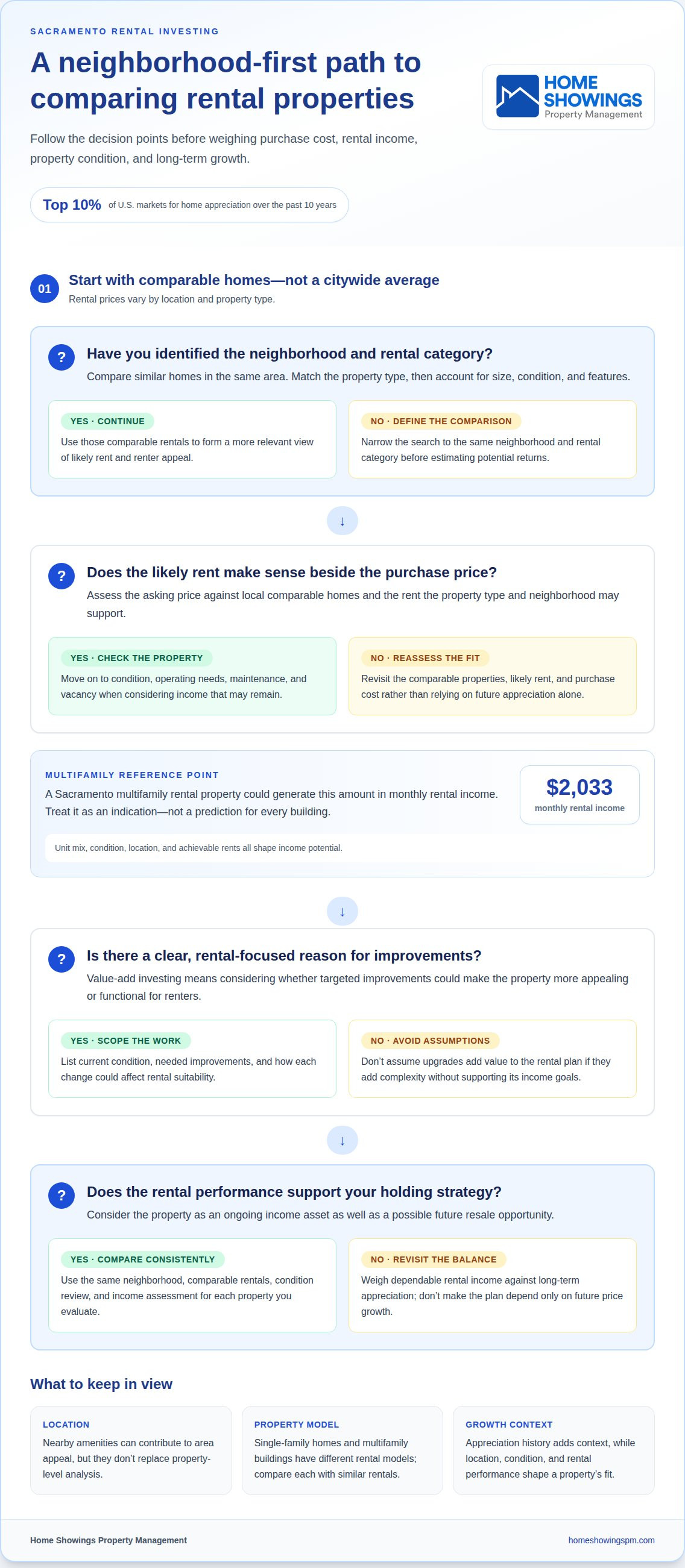
Compare Sacramento rentals by neighborhood, property type, and likely rent, not purchase price alone. Rental prices vary by location and property type, so a citywide estimate won’t describe every investment. Start with similar homes in the same area, then consider how size, condition, and features affect their appeal to renters. This provides a more useful picture of potential returns than a broad market average.
Multifamily properties may appeal to investors seeking rental income from multiple units. A Sacramento multifamily rental property could generate $2,033 in monthly rental income. Treat that figure as an indication, not a prediction for every building. Unit mix, condition, location, and achievable rents all shape a property’s income potential. Compare those factors with the purchase price before deciding whether the expected revenue supports your investment plan.
Neighborhood comparisons should also consider nearby amenities. For example, Sacramento’s American River Parkway offers trails, water recreation, and scenic views. Amenities can contribute to an area’s appeal, but they don’t replace property-level analysis. Consider the rental type and its features, then assess whether the location suits the renters you hope to attract. Don’t assume every home near a popular destination will perform alike.
Value-add investing means assessing whether targeted improvements could make a property more appealing or functional for renters. In 2025, multifamily and value-add investments were identified as potential Sacramento opportunities. Before pursuing one, list the property’s current condition, the improvements needed, and how each change could affect its rental suitability. A clear scope helps distinguish practical upgrades from work that adds complexity without supporting the investment’s income goals.
For a long-term rental, assess the property as an ongoing income asset, not just a future resale opportunity. Estimate rent using comparable properties in the same neighborhood and rental category. Then account for operating needs, maintenance, vacancies, and condition when estimating how much income may remain. Sacramento rental property value appreciation belongs in the broader picture, but an investment’s suitability also depends on whether rental performance supports your holding strategy.
A practical comparison has three steps: identify the neighborhood, match the property with similar rentals, and assess its condition and income potential. Apply the same steps to a single-family home and a multifamily building, recognizing that their rental models differ. Then consider whether a value-add plan has a clear purpose and supports long-term use. This approach lets you compare Sacramento opportunities consistently rather than relying on broad expectations about future growth.
2. What’s Driving the Sacramento Real Estate Market in 2025?
That gap offers buyers a useful statewide reference, but it doesn’t rank every Sacramento neighborhood. These are broad medians, not estimates for a specific home. Before comparing a listing with either figure, match property type, size, and condition. Smaller and larger homes can fall into different price brackets in the same city.
This measure helps compare properties of different sizes, but it needs context. A home’s condition, layout, and location affect how useful a per-square-foot comparison is. When comparing with a U.S. median, use the same property type and reporting period. That keeps the comparison meaningful rather than treating different housing markets as interchangeable.
Cost of living adds another affordability lens. Sacramento’s cost of living was 26% lower than Los Angeles’s, 65% lower than San Francisco’s, and 32% lower than Oakland’s. Those comparisons help explain why Sacramento may draw attention from people weighing coastal California against an inland city. They don’t mean that every Sacramento property is affordable or that its rents will produce a stronger return.
For an investor, affordability matters only when purchase cost and rental potential are considered together. Compare a Sacramento property’s asking price with similar local homes, then assess the rent its type and neighborhood may support. A lower cost of living than San Francisco or Los Angeles doesn’t establish the return on an individual rental. Condition, carrying costs, and renter appeal still matter.
Market conditions can also shift during 2025. Employment affects whether households can afford to move or rent, while interest rates influence financing costs and buyer demand. Housing policies can affect market activity and rental demand as well. These forces may interact: a change in borrowing costs can alter purchasing decisions, while employment trends can shape the pool of potential renters.
A useful market review compares Sacramento with California and national benchmarks, then returns to local property details. Check that comparable properties have similar size, condition, and rental use. Consider employment, interest rates, and housing policies together rather than relying on a single headline. Cost-of-living comparisons provide context, while median prices and per-square-foot figures offer separate ways to assess value.
3. Sacramento population growth and rental demand
Rental demand in Sacramento is supported by a large renter population and varied housing needs. About 53% of Sacramento residents were renters, indicating that rental housing serves a substantial share of local households. That figure gives investors useful context, but it doesn’t establish demand for every property or neighborhood. A home’s rental appeal still depends on its type, condition, location, and fit with the households seeking housing nearby.
Vacancy offers another lens. Sacramento’s rental vacancy rate was 2.88%, compared with a national rental vacancy rate of 6.6%. These figures suggest a tighter local rental market than the national rate, but they don’t predict how quickly any particular home will lease. For a practical assessment, compare a property with similar rentals nearby and consider whether its size, features, and location align with likely renter needs.
A diverse employment base can support housing demand by attracting workers with different skills and housing preferences. Healthcare, education, clean technology, and agriculture support Sacramento’s economy. These sectors may draw renters seeking homes near work, transit, or everyday services. When evaluating a property near an employment area, consider whether its layout and rental type suit workers seeking convenient access, without assuming every nearby job creates demand for that specific home.
Education adds another consideration. Sacramento State University, the University of California, and community colleges attract students, faculty, and staff who need housing. Their needs differ: students may prioritize campus access and shared living, while employees may seek other property types or locations. Use a nearby institution as a starting point, then assess whether the property suits the renters you intend to reach.
Market cycles, climate-related property conditions, and regulation can all affect Sacramento rental property value appreciation. A weaker market can slow price growth or rental demand; climate exposure can affect maintenance needs, and regulatory changes can alter operating assumptions. Assess the property’s condition and local rental context alongside broader market signals.
Demand and yield aren’t interchangeable. A low vacancy rate may indicate a tighter rental market, but it doesn’t show whether a property’s income will cover its purchase and ongoing costs. Neighborhood, rental type, and condition influence both achievable rent and the potential tenant pool. Compare similar rentals and consider employment and education demand together before judging a location’s income potential.
For a long-term investment, treat Sacramento’s renter share, vacancy rate, and institutional demand as related indicators, not guarantees of future performance. A stable tenant pool can support leasing prospects, while local job shifts, household preferences, and property upkeep can change a home’s appeal. Reviewing these factors together gives investors a clearer way to assess rental demand and its role in an appreciation strategy.
4. Cash flow versus property appreciation
Cash flow and appreciation support different parts of a Sacramento rental investment. Rental income can help cover ongoing costs, while appreciation reflects a change in property value over time. For Sacramento real estate investing in 2025, the practical priority is rental income that supports the investment, rather than relying on rapid price appreciation. That approach connects the purchase decision to the property’s operating performance.
Sacramento’s average traditional rental income was $1,676 per month. A single-family rental home could generate $1,718 in monthly rental income. These figures offer context, not a substitute for estimating income from a specific home. Compare the property with similar rentals by neighborhood and type, then consider how its condition and likely tenant appeal affect its income prospects.
Mortgage rates, property taxes, insurance, and maintenance reduce the income available after ownership costs and therefore affect returns. Mortgage payments shape financing outflow, while taxes, insurance, and repairs add ongoing expenses to include in a cash-flow review.
Build a property-level estimate before deciding whether rent supports a purchase. Start with expected rental income, then account for mortgage payments, property taxes, insurance, and maintenance. Consider how a vacancy or repair could affect cash flow, rather than assuming every month will produce the same result. This step-by-step view helps distinguish a property with workable income from one that depends heavily on future price growth.
Appreciation can strengthen an investment over a longer holding period, but it doesn’t pay recurring bills while an owner holds the property. A Sacramento rental may gain value over time, yet the investor still needs a plan for carrying costs and property upkeep. In 2025, placing rental income first means testing whether the investment can stand on its operating fundamentals before treating potential appreciation as an added benefit.
Use the same comparison across property types. A single-family home and a multifamily property may have different rental income and operating needs, so compare each against its own expected costs. The $1,718 monthly figure for a single-family rental and the $1,676 average for traditional rentals are reference points, not a direct performance ranking. Differences in location, condition, and rental type matter.
A balanced decision considers both income and long-term value, starting with cash flow. Compare expected rent with financing and ownership costs, then consider how the property fits a longer holding strategy. This keeps Sacramento investment decisions grounded in the income a property may produce, rather than relying on rapid appreciation alone.
5. Sacramento home value appreciation over the past decade
Sacramento ranked in the top 10% of U.S. markets for home appreciation over the past 10 years. That record makes the city’s long-term price performance a relevant part of rental investment analysis. It describes Sacramento’s position among U.S. markets over that period, not the outcome for every neighborhood or property. A citywide ranking offers context; an individual home still needs its own valuation.
For investors, the useful question is how that history applies to a property they might hold. Start with its purchase price and compare it with similar homes in the same neighborhood. Consider property type, condition, and features to make the comparison meaningful. A single-family rental and a multifamily building serve different purposes, so their values shouldn’t be treated as interchangeable.
Next, separate price appreciation from rental performance. A property’s value may rise over time, while its income depends on achievable rent and ownership costs. Reviewing both helps clarify whether an investment’s appeal rests mainly on future resale value or on operating it as a rental. Sacramento’s decade-long appreciation record adds perspective, but doesn’t replace a property-level review of income and condition.
Neighborhood context matters, too. Compare a property with nearby homes of the same rental type and similar features. Then consider whether changes in the surrounding area support its appeal to renters and future buyers. Sacramento’s American River Parkway, for example, offers trails, water recreation, and scenic views. It can inform a location review, but doesn’t establish the value of a specific home.
A practical review has three steps: document the property’s condition, compare it with similar local homes, and assess its rental use. This creates a clearer baseline for tracking the asset over a longer holding period. Keep rental income and property value as separate measures: a strong historical appreciation ranking doesn’t show whether rent covers ongoing costs.
Sacramento’s high appreciation over the preceding decade is a meaningful historical signal, especially for investors considering long-term ownership. Use that record as context, not as a substitute for local comparisons or rental analysis. For a specific property, assess its neighborhood, condition, rental suitability, and income potential together. This keeps past growth in view while grounding the decision in the home itself.
Home Showings Property Management: Property Management
Home Showings Property Management helps rental owners manage key steps between preparing a property and collecting rent. If you’re turning a Sacramento investment into a long-term rental, Property Management can bring Rental Marketing, Tenant Screening, and Rent Collection together around your ownership needs. These services support the day-to-day work behind attracting renters, selecting tenants, and managing rental income. They complement your own assessment of neighborhood prices, property condition, and long-term value potential. For a clearer process as you move from investment analysis to rental operations, visit Home Showings Property Management.
Turn your Sacramento investment goals into a clear plan
Choosing a rental property is only the beginning. Define what success means for your investment, whether that’s steady rental income, preserving the home’s condition, or holding it for future value growth. Let that goal guide your property decisions and day-to-day priorities.
Sacramento rental property value appreciation can inform a long-term plan, but how you operate the rental matters, too. Clear processes for marketing, tenant screening, and property management help keep the investment organized as your needs evolve. Home Showings Property Management supports owners with rental marketing, tenant screening, rent collection, maintenance, and inspections, so you can focus on informed decisions about the asset.
Ready to discuss the next step for your rental property? Contact Home Showings Property Management to talk through your goals and move forward with a considered plan.
Frequently Asked Questions
So, what does this mean for you?
Choosing a Sacramento rental means balancing income needs with your holding plans. Before making an offer, decide what the property should deliver: rental income, potential long-term value growth, or a blend of both. Then compare similar homes in the same area and assess their condition and rental suitability. This turns broad market trends into a property-level decision you can evaluate against your investment goals.
What’s Driving the Sacramento Real Estate Market in 2025?
Employment, interest rates, and housing policies are key forces to watch in Sacramento during 2025. Consider how each could affect both your purchase assumptions and the renter pool for a particular property. For example, a change in borrowing costs can alter financing calculations, while employment shifts may affect housing demand. Reviewing these factors together gives you a more useful basis for planning than relying on a single market headline.
How much have Sacramento home values appreciated over the past 5, 10, and 20 years?
There isn’t one appreciation amount that applies to every Sacramento home across those periods. To calculate a meaningful change, compare consistent home-value measures at the start and end of each period, using the same property type and geographic area. A five-year result may differ from a longer-term measure because the dates capture different market conditions. Keep the timeframe and measurement consistent before drawing conclusions about an investment.
How does Sacramento rental property appreciation compare with California and U.S. averages?
Compare Sacramento’s home-value change with California and U.S. benchmarks over the same timeframe and using the same measure. Rental income and property appreciation are different measures, so don’t compare local rent figures with statewide home-price changes. Also distinguish citywide trends from a property’s neighborhood and type. This helps show whether Sacramento’s performance tracks broader markets or reflects local conditions relevant to your investment.
Which Sacramento neighborhoods have seen the highest home price appreciation?
Identifying the strongest neighborhood requires comparing local sales over a consistent period, using similar property types and conditions. Don’t assume nearby areas share the same price movement. Compare Sacramento separately with Natomas, Elk Grove, Folsom, Roseville, Rancho Cordova, North Lake Sacramento, El Dorado Hills, Citrus Heights, and Carmichael. These comparisons can help define your search area, but don’t establish an appreciation ranking.
What are Sacramento home price forecasts for the next 1, 5, and 10 years?
Build separate short- and long-term scenarios rather than treating one projection as a fixed outcome. For a one-year view, examine current financing conditions and local employment. For five- and ten-year planning, consider how housing policies, rental demand, and property condition may affect appeal. Use consistent assumptions across each scenario, then test whether the investment still fits your goals if conditions change.
What local factors drive Sacramento rental property values and appreciation?
Local job opportunities, education-related housing needs, neighborhood amenities, and the property itself can all shape rental appeal and value. Consider how the home’s layout, condition, and access to daily needs suit likely renters. Nearby institutions such as Sacramento State University or community colleges may influence housing needs in surrounding areas. Assess these local features alongside the property’s rental type instead of relying on a citywide trend alone.
What California and Sacramento rental housing laws can affect property values and investor returns?
Housing policies can affect rental demand and investment assumptions, so include applicable requirements in your operating plan. Before estimating returns, identify the rules that apply to the property and rental arrangement, then account for possible effects on income, costs, or management practices. Keep these assumptions current as you review an investment. This helps you compare properties thoughtfully without treating regulatory conditions as identical across every rental.



Comments