
Sacramento Landlord HOA Compliance: Rules and Deadlines

No, an HOA rule cannot override applicable federal, California, or local law. California’s Davis-Stirling Common Interest Development Act, codified in Civil Code §§4000-6150, governs HOA operations, and association rules must be consistent with governing documents and applicable law. This Sacramento landlord guide to HOA compliance explains how that hierarchy affects rental properties.
It’s understandable to feel caught between an association’s expectations and your responsibilities as a housing provider. HOA rules can set community standards, but they don’t replace state or local requirements.
This guide explains how CC&Rs, bylaws, and HOA rules fit together, what to do when a notice arrives, and how rental standards and nuisance rules may affect tenants. It also covers how clear communication and organized records can help you manage deadlines, decisions, and compliance responsibilities.
Table of Contents
What are HOA rules and regulations?
In California, HOA rules govern community conduct but are subject to the association’s recorded CC&Rs and bylaws. This Sacramento landlord guide to HOA compliance starts with identifying which document governs a rental restriction, tenant standard, or property change.
Governing Document Hierarchies
A governing-document hierarchy ranks an association’s documents by authority, from recorded CC&Rs or declarations and bylaws to rules and regulations. That order matters when a community rule appears to conflict with a broader restriction. For example, a rule about trash-bin placement should be read alongside the documents that establish the association’s authority.
CC&Rs describe restrictions and association authority, while bylaws address association governance. Rules and regulations provide more detailed operating standards, such as pet limits, fence height, or shared-space use. California CC&Rs are recorded with the county, and changing them requires a membership vote. In most cases, a board may adopt rules by board vote without a full membership vote, if the governing documents and state law allow it.
Consistency With Governing Documents and State Law
Consistency means an HOA rule must align with the association’s CC&Rs, bylaws, and applicable law. A conflicting rule is unenforceable, so landlords should compare the text of a restriction with the documents that authorize it. California’s Davis-Stirling Common Interest Development Act governs homeowners associations and is codified in Civil Code §§4000-6150.
For rentals, compare lease requirements and tenant conduct rules with the governing documents. An HOA may require rental agreements to refer to association documents, but those rules cannot conflict with federal, state, or local law. When a board adopts or changes a rule, California’s Davis-Stirling Act requires advance notice to residents, a fair hearing process, and clear communication of decisions. Keep the rule and its supporting provisions together when explaining expectations to tenants.
Obtaining HOA Governing Documents
Gather the current CC&Rs, bylaws, rules, and architectural guidelines that apply to the property. Sacramento landlords can request these documents from the association or its management office. Because CC&Rs are recorded with the county, county records may also help locate the declaration. Request rules and architectural guidelines separately if they’re maintained apart from recorded documents.
Compare document versions and note adoption or revision dates where provided. Keep the declaration, bylaws, current rules, architectural standards, and written updates in one property file. If a guideline covers exterior alterations, save it with related approval correspondence. If a rule concerns tenant conduct, include it with rental materials. This Sacramento landlord guide to HOA compliance offers a practical starting point for finding the documents and understanding how they apply.
Violation notices, hearings, and opportunities to cure
An HOA notice should identify the alleged violation, the governing rule, and the association’s next steps. In California, homeowners have an opportunity to respond and correct an issue before a fine or lawsuit based on that violation.
For tenant-caused violations, the HOA addresses its member, usually the property owner, while the landlord remains responsible for enforcing community rules with renters. The lease sets expectations between landlord and tenant, so explain applicable rules and responsibilities in writing.
Start by matching the notice to the rule it cites. Record when it arrived, the response deadline, the alleged conduct, and any instructions for requesting a hearing. If the issue involves a tenant’s parking, noise, or use of a common area, contact the tenant promptly, explain the specific concern, and document the response and corrective action.
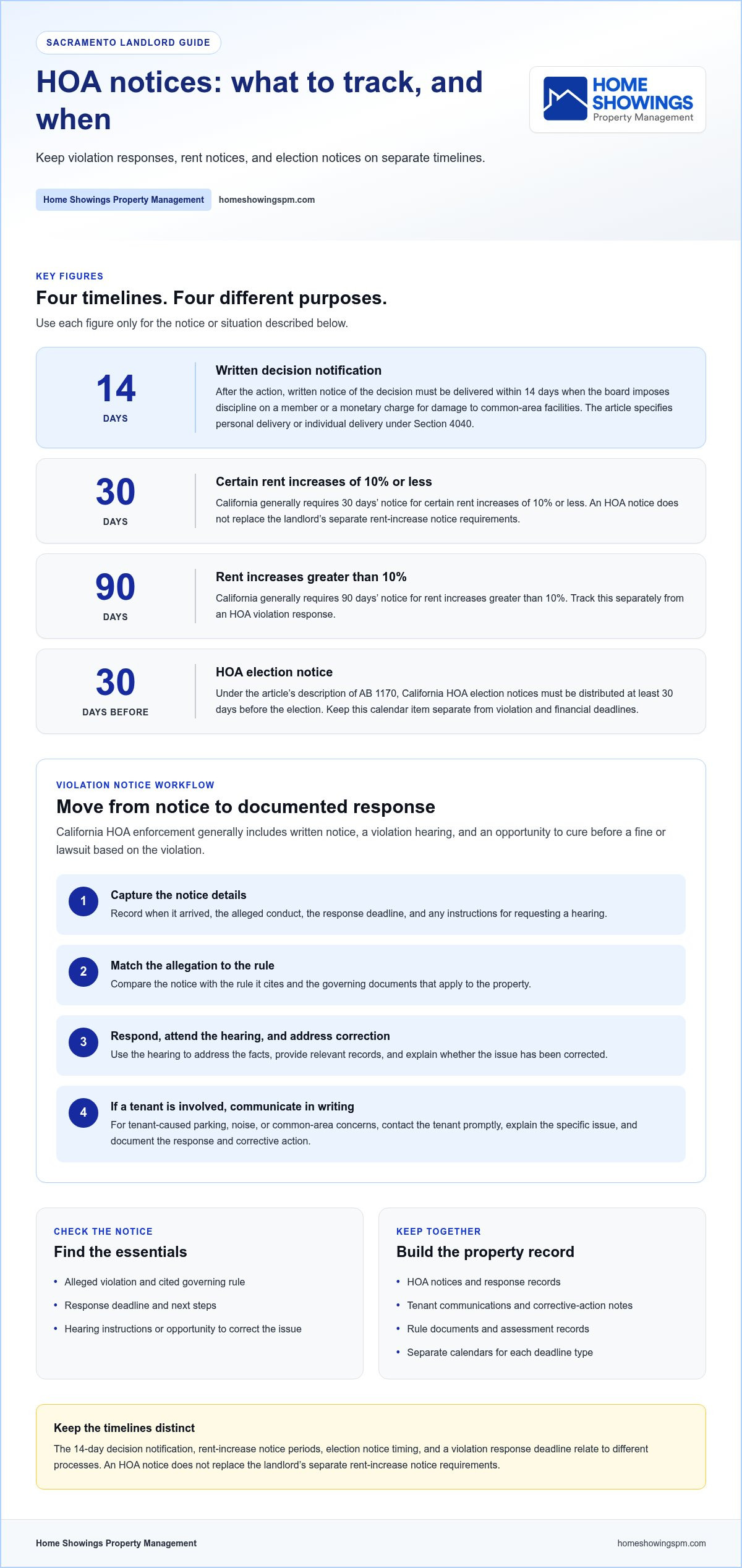
California HOA enforcement generally includes written notice, a violation hearing, and an opportunity to cure before a fine or lawsuit based on the violation. Use the hearing to address the facts, provide relevant records, and explain whether the issue has been corrected. If the board imposes discipline on a member or a monetary charge for damage to common area facilities, the California Legislature requires written notification of its decision, by personal delivery or individual delivery under Section 4040, within 14 days following the action.
Keep HOA fines separate from rent changes. California generally requires 30 days’ notice for certain rent increases of 10% or less, and 90 days’ notice for increases greater than 10%. An HOA notice does not replace the landlord’s separate rent-increase notice requirements.
Election procedures also have their own calendar. Under the page’s description of AB 1170, California HOA election notices must be distributed at least 30 days before the election. Track that association election notice separately from a violation response or financial deadline; each serves a different purpose.
For rental operations, owner and tenant portals can support organized communication between landlords and renters, including when sharing HOA notices and documenting follow-up.
Sacramento rental compliance and overlapping laws
A Sacramento rental may be subject to HOA restrictions, California housing laws, and local registration or inspection requirements. Keep each obligation distinct: HOA approval doesn’t replace public compliance.
Rental Restrictions and Lease Requirements
Rental restrictions set community conditions for leasing, while lease requirements carry applicable HOA rules into the landlord-tenant relationship. California Civil Code Section 4740 allows HOAs to enforce reasonable rental restrictions, subject to certain limits. Some California communities cap rentals or require leases to last at least 12 months, so the property’s governing documents can affect when and how owners rent.
In a 55+ community, rental requirements can include age qualifications for tenants. The Sun City communities described require at least one occupant to be 55 or older. Separate fair housing duties still apply: California and federal laws prohibit discrimination based on protected characteristics, while allowing landlords to use lawful, nondiscriminatory screening criteria.
Tenant Disclosures About HOA Rules
Sacramento landlords must provide tenants with the HOA rules and regulations that apply to their use of the property. Share the relevant documents before move-in, then explain practical expectations for parking, pets, trash, amenities, and conduct. Clear disclosure helps residents understand standards that might otherwise seem like informal requests.
Include HOA rules as a condition of the rental agreement and retain a record of which rules the tenant received. If the association updates a rule, explain the change and its practical effect. Renters generally receive the landlord’s right to use community amenities, but not the landlord’s voting or membership rights.
Tenant Registration and HOA Approval
Tenant registration and HOA approval are separate processes: one may involve the association, while another relates to city rental requirements. First, review the community’s rental restrictions and approval procedure. Then provide any required lease or tenant information to the association, obtain required approval before move-in, and keep the submission and response with the rental records.
For properties within Sacramento city limits, the city requires annual rental-unit registration. Its Rental Housing Inspection Program also requires periodic interior inspections according to each property’s inspection schedule. Treat these city obligations separately from HOA tenant approval: completing one doesn’t complete the other.
In unincorporated Sacramento County, the Substandard Housing Program addresses complaints from occupants, Code Enforcement staff, and other agencies. Priority housing violations should receive inspection within 72 hours after a complaint. For non-priority violations, a warning letter gives owners and managers approximately 30 days to make repairs. Confirmed violations may result in inspection costs, and ongoing violations can lead to administrative penalties. Keep HOA correspondence, registration records, and inspection responses organized by property to distinguish these requirements.
Noise, nuisance, trash, and recycling rules
Community rules shape daily tenant conduct, from noise and shared-space use to trash storage and recycling. In Sacramento, owners should read the governing documents to understand the association’s authority, enforcement process, and expectations for residents. For example, a tenant who leaves bins beside a walkway may raise concerns about both bin placement and access to a common area.
Noise rules may address disruptive activity, while nuisance provisions can cover conduct that affects neighbors or shared spaces. Trash requirements may specify where residents place bins and how collection areas must be kept. Recycling instructions may also appear in community rules. Give tenants clear directions about bin locations and collection procedures rather than relying on a general reminder to be considerate. If a complaint arrives, identify the reported conduct, location, and cited rule before responding.
In Roseville, as in Sacramento, association rules vary between communities. Use the documents for the specific property rather than assuming a nearby association follows the same standards. One community, for example, may give detailed bin-placement instructions, while another may focus on keeping walkways or shared areas clear. Use the current written rules to explain what residents should expect.
EV charging equipment calls for a careful review of governing documents, architectural guidelines, and applicable insurance provisions. Before installation, identify the approval process and review the requirements for the equipment, its placement, and coverage. Keep written rules and approval correspondence with related records. Don’t assume a general parking rule answers questions about charger location or insurance; review the documents that apply to the property.
Review community rules annually and compare the current version with the copy in the property file. Check topics such as noise, pets, parking, trash, recycling, amenities, and safety. California HOA policies adopted five years ago may no longer be relevant, so a regular review can help identify provisions that need attention. Record the review date and communicate applicable rule changes to tenants.
Clear, specific communication supports consistent enforcement. If a tenant places bins where the association prohibits them, point to the written location rule and explain the correct placement. If a noise complaint involves a shared space, record the reported conduct and cited provision. The governing documents establish the association’s authority, while dated records help distinguish a formal requirement from an informal neighbor request and guide follow-up.
Compliance recordkeeping and deadline calendars
A property-specific records system helps Sacramento landlords connect association rules, tenant communications, and deadlines. Keep digital copies of governing documents, leases, HOA correspondence, assessment statements, inspection records, and proof of delivery. Label each file by property and date. This makes it easier to distinguish a current rule from an older version and find the right record when an owner, tenant, or association requests information.
Build calendar reminders from the date each obligation begins, not just its final due date. In Sacramento, HOA assessments are considered late 14 days after their due date, according to the California Legislature. Record the assessment amount, due date, payment date, and receipt together. Add reminders ahead of the due date, then retain the statement and payment confirmation in the same file. This creates a clear financial trail if an account is questioned.
Association records also have response windows. California associations must deliver or make requested records available within 5-10 days after a homeowner’s request, depending on the record. Save the request, its delivery date, and the response received. The Annual Policy Statement must be distributed to members within 30-90 days after the fiscal year ends. Add the association’s fiscal-year end and statement deadline to the calendar when that information is available.
Track inspections and maintenance separately from financial records. California condominium HOAs with three or more units were required to complete initial SB 326 inspections of qualifying exterior elevated elements by January 1, 2025. Reinspections are required every 9 years after the initial inspection. For a rental property, retain relevant association communications alongside property inspection reports, repair records, and tenant updates. Those files help clarify whether a concern involves the unit, common areas, or association responsibilities.
Schedule an annual review of governing documents, community rules, and calendar entries. Compare current documents with the versions in the property file, then update reminders for assessments, inspection cycles, and association communications. Keep meeting materials and decisions with the rule or issue they concern. If a dispute later involves common areas, a dated record can show what the association communicated and how the owner responded. An attorney may need a clear chronology, not scattered messages.
Use a consistent naming system, such as property name, document type, and date, for each saved file. Owner and tenant portals can help keep property-related communications accessible in one place. Pair that record with the original HOA documents and payment receipts, so the calendar points to evidence rather than serving as a reminder alone.
Home Showings Property Management: Property Management
Home Showings Property Management can help Sacramento rental owners coordinate the day-to-day work that supports HOA compliance. Consider Property Management when tenant communications, rental administration, and consistent follow-through are taking time away from other responsibilities.
Rental Marketing and Tenant Screening support the leasing process, while Rent Collection helps organize incoming payments. Clear leasing operations make it easier to share community expectations with residents and keep rental matters on track. Property Management is a practical fit when you want these responsibilities handled as part of a coordinated service.
For information about Property Management, contact Home Showings Property Management or visit the company online.
Make compliance part of your rental routine
HOA compliance works best as an ongoing part of rental operations, not a scramble after a notice arrives. Establish a routine for communicating community expectations, keeping property records accessible, and reviewing changes before they affect a tenant. A steady process can help you identify which issues need prompt attention and which call for a closer review of the governing documents.
Use this Sacramento landlord guide to HOA compliance when setting up your routine. If managing the rental alongside association requirements is taking more time than you can comfortably give it, contact Home Showings Property Management to discuss a more organized approach to ownership.
Contact Home Showings Property Management to discuss your rental management needs. With the right systems in place, you can move forward with greater clarity and keep your attention on the property’s long-term care.
Frequently Asked Questions
Can HOA rules override state or local law?
No. HOA rules must comply with applicable federal, California, and local laws, as well as the association’s governing documents. A rule that conflicts with controlling law or those documents is unenforceable. For example, a community rule about tenant conduct may set reasonable standards for shared spaces, but it cannot displace legal housing protections or municipal requirements that apply to the rental.
Can the HOA board make new rules without homeowner approval?
Generally, yes. In California, an HOA board can adopt rules by board vote without a full membership vote when the governing documents and state law allow it. The board must follow applicable procedures, including providing advance notice before adopting or changing rules. A new rule must still fit the association’s governing documents and applicable law, so a board vote alone doesn’t make every proposed restriction enforceable.
How Can Sacramento Landlords Stay Organized With Multiple Compliance Deadlines?
Use a property-specific calendar and link each reminder to its supporting record. Keep separate entries for HOA assessments, city registration, inspection schedules, lease dates, and notice response deadlines. Set a reminder ahead of each due date, and save proof of payment or submission alongside the calendar entry. For a rental in an HOA, this makes it easier to distinguish association obligations from those imposed by a public agency.
What HOA rules apply to rental properties in Sacramento, California?
The rules depend on the community’s current governing documents. Rental-related standards may address lease terms, tenant approval, pets, parking, noise, trash, amenities, move-ins, and conduct in common areas. Before leasing, identify requirements that affect both the owner and tenant, then communicate relevant rules during the leasing process. One Sacramento association’s rules may differ from another’s, even when both properties are residential rentals.
Can Sacramento HOAs restrict or prohibit rentals, and what state laws limit those restrictions?
California HOAs may impose reasonable rental restrictions, subject to statutory limits. California Civil Code Section 4740 addresses those restrictions, and the association’s governing documents determine how its rental policy applies to a property. Check for rental caps, lease conditions, or approval requirements before offering the home. Fair housing laws also limit discriminatory housing practices, so rental rules and screening must be applied without unlawful discrimination.
What risks and penalties can Sacramento landlords face for HOA noncompliance?
Noncompliance can lead to violation proceedings, monetary fines, or charges for damage to common areas, if authorized by the governing documents and law. Delinquent assessments may also lead to a statutory lien; authorized late fees, interest, and collection costs may be included. An unresolved violation can progress toward litigation after required procedures. Specific consequences depend on the rule, notice, and association enforcement policy.
How can landlords appeal an HOA violation or dispute fines in California?
Respond through the process described in the notice and governing documents. Identify the cited rule, gather relevant evidence such as dated photographs or tenant communications, and request the available hearing or review. Explain whether the violation occurred, has been corrected, or was attributed to the wrong property. California associations must provide notice, a violation hearing, and an opportunity to cure before imposing a fine or suing based on a violation.
Do Sacramento County or city rental laws add requirements beyond HOA rules?
Yes. A property within Sacramento city limits is subject to annual rental-unit registration and the city’s periodic inspection schedule. Sacramento County’s Substandard Housing Program addresses housing complaints and violations within its jurisdiction. These public requirements operate separately from HOA rules, so determine whether the property is within city limits or unincorporated county territory. Completing an HOA tenant process doesn’t replace applicable local registration or inspection duties.



Comments