
Rental Property Accounting: What Folsom Landlords Should Track

A rental property's return is only as clear as its records. This Folsom landlord guide to rental property accounting starts with a practical rule: track income and expenses for each property, then use the records to understand what remains after costs. In most cases, the Internal Revenue Service requires landlords to report rental income and expenses on Schedule E (Form 1040). Keeping transactions organized makes it easier to see how rent, repairs, maintenance, and other costs affect your property’s performance.
It’s easy to focus on rent coming in, but useful rental accounting also tracks expenses and keeps supporting records together. This Folsom landlord guide to rental property accounting explains what income and costs to record, how deductible expenses and depreciation may affect your taxes, and how organized management records support oversight. The aim is a clear view of your rental’s finances without creating unnecessary paperwork.
Table of Contents
1. Tracking rental income and expenses
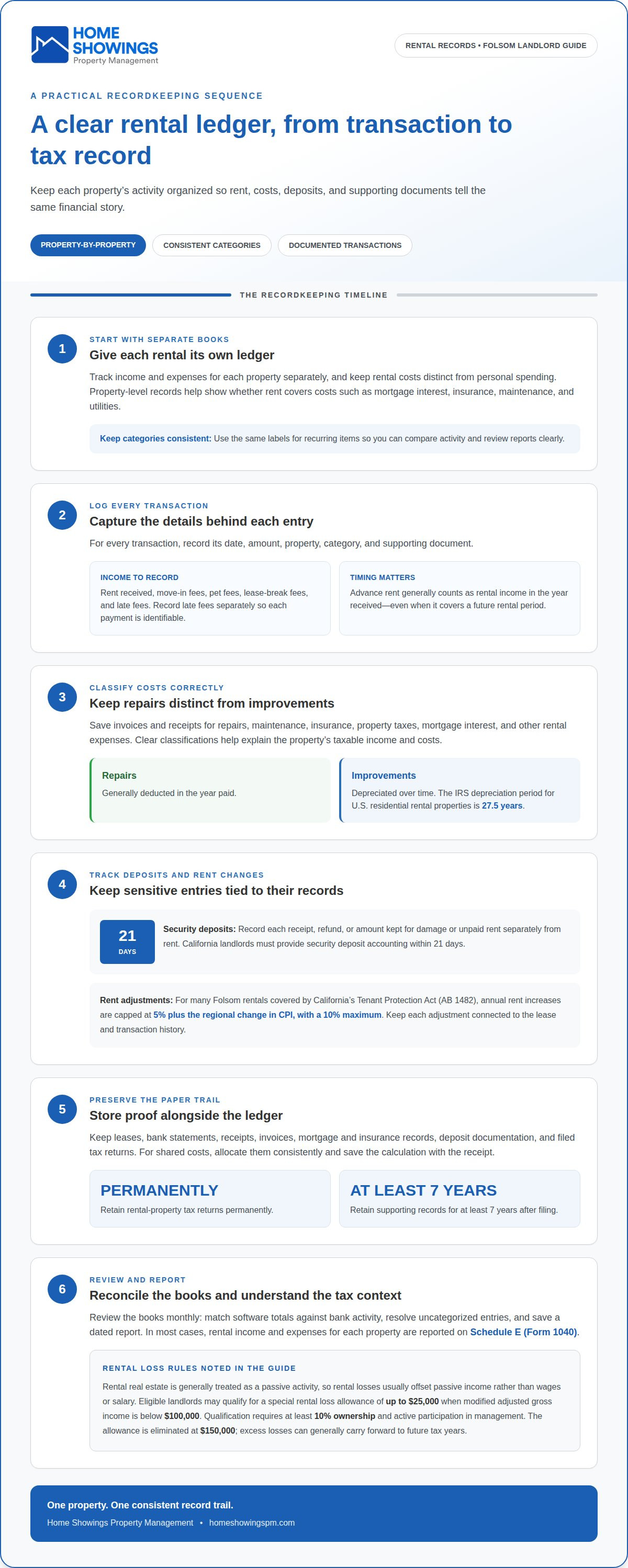
For each rental, maintain a separate ledger of income and expenses. In most cases, the Internal Revenue Service requires U.S. landlords to report rental income and expenses for each property on Schedule E (Form 1040). This Folsom landlord guide to rental property accounting begins with property-level records, which help show whether rent covers costs such as mortgage interest, insurance, maintenance, and utilities.
Record each transaction with its date, amount, property, category, and supporting document. Track rent when received, along with move-in, pet, and lease-break fees. Advance rent generally counts as rental income in the year received, even when it covers a future rental period. Record late fees separately so the ledger shows what each payment represents.
Keep property costs distinct from personal spending. Save invoices and receipts for repairs, maintenance, insurance, property taxes, mortgage interest, and other rental expenses. Repairs are generally deducted in the year paid, while improvements are depreciated over time. The Internal Revenue Service sets the depreciation period for U.S. residential rental properties at 27.5 years. Clear classifications help explain the property’s taxable income and costs.
Rental real estate is generally treated as a passive activity, so rental losses usually offset passive income rather than wages or salary. Eligible landlords may qualify for a special rental loss allowance of up to $25,000 when modified adjusted gross income is below $100,000. Qualification requires owning at least 10 percent of the property and actively participating in its management. It is eliminated at $150,000. Excess losses can generally carry forward to future tax years.
Keep leases, bank statements, receipts, invoices, mortgage and insurance records, deposit documentation, and filed tax returns. Retain rental-property tax returns permanently and supporting records for at least 7 years after filing.
Record security deposits separately from rent, documenting each receipt, refund, or amount kept for damage or unpaid rent. California landlords must provide security deposit accounting within 21 days, regardless of where they live, according to the California Legislature.
For many Folsom rentals covered by California's Tenant Protection Act (AB 1482), the California Legislature says annual rent increases are capped at 5% plus the regional change in CPI, with a 10% maximum. A Folsom landlord guide to rental property accounting should account for rent changes alongside the lease and transaction history, keeping each adjustment tied to its supporting records.
2. What Are the Basic Principles of Rental Property Accounting?
A workable accounting system assigns every transaction a consistent category and keeps rental activity separate from personal spending. For one or two straightforward rentals, a spreadsheet may be enough to track the basics. Accounting software can help when recurring transactions, repairs, and reporting become difficult to manage manually. With either method, consistent entries matter more than the tool.
Rental property accounting software can organize rent receipts, invoices, and expense categories in one place. Create a separate profile for each property, then label transactions such as rent, insurance, repairs, utilities, and mortgage interest. Use the same categories each month to make reports comparable. If a cost applies to multiple properties, allocate it consistently and save the calculation with the receipt.
Cash-basis accounting records income when received and expenses when paid, making monthly cash flow straightforward to follow. Accrual accounting records income when earned and costs when incurred. Choose a method suited to your reporting needs and apply it consistently. For example, record rent received in one month and a repair invoice paid later according to the method you use, rather than mixing approaches.
Useful software features include transaction categories, receipt storage, property-level reports, and exportable records. Before choosing a system, enter a rent payment, a maintenance invoice, and a refund to see how each appears. Check that reports separate income from expenses and that you can trace entries back to their documents. A spreadsheet can also work if you maintain its formulas, categories, and backup copies carefully.
For federal reporting, rental income and expenses are generally reported for each property on Schedule E (Form 1040), according to the Internal Revenue Service. California landlords also account for rental activity on their state income tax return; the records should reconcile with the federal figures while reflecting state reporting needs. Keep the supporting ledger and receipts organized alongside the filed returns.
For landlords in Folsom and Sacramento County, keep accounting records specific enough to explain each charge. Record property tax payments from the bill, identify the parcel, and retain notices explaining adjustments. For a rent or deposit matter, keep the lease, tenant ledger, and related correspondence together. This helps show both the transaction and the reason behind it.
Review the books monthly. Match software totals against bank activity, resolve uncategorized entries, and save a dated report. If you want rental operations and financial activity organized together, property management support can connect rent collection and maintenance records with the property’s ongoing oversight.
3. Property management companies and rental accounting
A property manager can link everyday rental operations with organized financial records. Rent collection, maintenance coordination, and inspections all generate transactions or documents for the property’s accounting file. For example, connect a maintenance invoice to the property, work performed, payment, and receipt. This record trail helps owners understand operating costs and prepare organized financial reports.
Before hiring a property manager for accounting support, decide which reports and records you need. Look for property-level income and expense summaries, transaction details, and supporting documents. Establish how rent, refunds, maintenance bills, property taxes, and owner disbursements will appear in the records. Consistent categories make it easier to compare statements with bank activity and follow up on questions.
When a tenant misses a payment, the ledger should show the rent due, amount received, date received, and outstanding balance. Keep notices and relevant communications with the account record so the payment history and follow-up stay connected. If the tenant disputes a charge, identify it separately and retain invoices, receipts, and lease records. This preserves a clear transaction history without treating an unresolved amount as payment received.
California generally limits residential security deposits to one month’s rent, according to the California Legislature. Track each deposit separately from rent, recording its receipt and any refund. Document any amount retained alongside the relevant property expense or tenant balance. Separating these entries helps distinguish money held for a tenant from rental income available for property expenses.
To reconcile rental finances, compare the property ledger with bank statements and payment records. Match each deposit to rent or another identified receipt, then match withdrawals to invoices, taxes, insurance, or maintenance costs. Investigate unmatched entries instead of assigning them to a convenient category. At year-end, organize reconciled records by property so income, expenses, and supporting documents are ready for tax reporting.
Professional property management can help when coordinating tenants, payments, repairs, and records becomes difficult to do consistently. It does not replace an owner’s tax decisions, but it can support the operational records those decisions rely on. For example, recording a repair invoice against the correct property gives the owner a clearer view of the expense.
Review the reporting arrangement when management begins and whenever responsibilities change. Clarify who records tenant payments, tracks outstanding balances, files maintenance documents, and prepares owner statements. A defined process reduces gaps between the tenant ledger, bank activity, and property expenses, giving owners a more dependable basis for reviewing rental performance.
4. What rental expenses can I deduct on my taxes?
For a Folsom rental, start by separating operating expenses from improvements. The Internal Revenue Service lists advertising, cleaning, landlord insurance, maintenance, legal fees, mortgage interest, property taxes, utilities, and homeowners association fees among reportable expenses. Match each cost to the property, payment date, and receipt so the record supports your tax return.
Common operating expenses include:
Advertising costs for rental marketing and tenant screening.
Cleaning and maintenance tied to preparing or preserving the property.
Landlord insurance, utilities, property taxes, and homeowners association fees.
Mortgage interest, legal fees, and eligible software used for rental operations.
Business travel related to the property, recorded with its purpose and documentation.
Keep these costs in a dedicated ledger or bank account rather than combining them with personal spending. For example, record a cleaning invoice separately from rent received and save the receipt with the property records. If property taxes change after an assessment or improvement, retain the bill and record the payment against the correct rental.
Repairs and capital improvements receive different tax treatment. In the United States, landlords generally deduct repairs in the year paid, while improvements are depreciated over time. A repair restores an existing feature, such as fixing a leaking faucet; an improvement adds value or extends useful life, such as a substantial renovation. Keep invoices, work descriptions, and payment records to support the classification.
The Internal Revenue Service sets the depreciation period for U.S. residential rental properties at 27.5 years. Qualifying appliances, carpeting, and property improvements may use 5-7 year depreciation schedules. Depreciation spreads an eligible cost across time instead of deducting the full amount as a current operating expense. A real estate accountant can help identify applicable deductions and calculate and report depreciation in line with tax rules.
Unexpected expenses can disrupt cash flow, especially after property damage or an urgent system failure. Keep maintenance invoices and inspection notes together, then record the expense when paid. A reserve equal to 3-6 months of rental-property operating expenses can help prepare for vacancies and maintenance, while keeping emergency costs distinct from routine work.
Careful documentation keeps each claimed deduction connected to its supporting record. Store receipts, contracts, invoices, and payment confirmations by property and expense category. For example, if a contractor replaces a damaged fixture, retain the invoice and work description. These details help distinguish a repair from an upgrade and provide a clear record for tax reporting.
Section 8 landlords may also face unexpected repair expenses if a tenant damages the property, so retain the related invoices and payment records. The 2025 U.S. mileage deduction rate for rental-property business trips is $0.67 per mile; keep trip details and mileage records with the expense documentation.
5. Accounting practices to maximize return on investment
Bookkeeping is more useful when it shows where rental income goes, not just how much rent comes in. Start with a monthly property statement that separates collected rent, operating costs, loan payments, and owner contributions. Compare the categories across months to spot rising costs, late payments, or vacancy periods. A clear transaction history helps distinguish a change in performance from a timing difference.
Calculate cash flow by subtracting operating expenses and debt payments from rental income received. Net operating income, or NOI, is rental income after operating expenses but before mortgage payments and income taxes. Keeping the measures separate matters: a property can have positive NOI while loan payments reduce its remaining cash. Show both figures on separate lines in the same statement.
To calculate a basic return on investment, divide the chosen annual return by the total amount invested, then multiply by 100. State which return you use: NOI, cash flow after debt service, or another clearly defined measure. Those figures answer different questions. NOI helps compare property operations, while cash flow reflects financing costs and available funds. Using the same formula each year makes the comparison meaningful.
Use the same transaction categories every month. Separate rent and other rental income from repairs, insurance, property taxes, utilities, and management costs. Record owner contributions and loan principal separately from operating expenses. Principal payments affect cash flow but are not the same as deductible operating costs. Keep receipts and bank statements connected to each entry so you can trace the amount later.
Monthly reconciliation can catch errors before they affect a yearly return. Match deposits to rent records, then compare withdrawals with invoices and account statements. Investigate unmatched payments rather than assigning them to a convenient category. If rent arrives late, record it when received and retain the balance due in the tenant ledger. This makes income timing visible in financial reports.
Review performance alongside property decisions. If maintenance costs rise, compare invoices and work descriptions across periods to see whether the issue is recurring or exceptional. If rental income changes, separate vacancy and collection effects from expense changes. A rental’s return reflects both revenue and cost control, so higher rent alone does not show whether the investment is performing better.
Consistent bookkeeping gives owners a stronger basis for planning, but rent collection is a key part of the record. Get support with rent collection to keep payment activity organized for your rental’s financial review.
Home Showings Property Management: Rental Marketing
Home Showings Property Management supports Folsom rental owners with property operations and leasing. When a vacancy requires advertising, applicant review, and rent collection, the company’s rental marketing, tenant screening, rent collection, and property management services can support those steps. A consistent process helps keep leasing activity and payment records organized alongside your rental accounting, with clear support for ongoing property oversight.
To discuss help managing your rental, contact Home Showings Property Management about your property.
Make your next rental decision with clarity
Let each accounting review lead to a practical decision, not just a completed report. Before your next review, choose a question to answer: should you adjust the maintenance plan, prepare for a lease transition, or revisit how the property fits your investment goals? Regular reviews turn financial records into a planning tool, helping you make deliberate choices instead of reacting to the latest expense.
A Folsom landlord guide to rental property accounting can help you build a useful routine, but its value comes from applying it consistently. If managing rental operations alongside financial decisions is taking more attention than you want to give it, Home Showings Property Management offers property management, rental marketing, and tenant screening.
For a conversation about your rental property needs, contact Home Showings Property Management. A clear next step can make it easier to move forward with confidence.
Frequently Asked Questions
What Are the Basic Principles of Rental Property Accounting?
Good rental accounting makes every transaction traceable to a property, category, and supporting record. For example, if a tenant pays rent and a plumber’s invoice arrives in the same week, enter them separately rather than netting one against the other. This keeps gross income and costs visible, helps explain changes in a property’s results, and makes financial reviews easier to follow.
What rental expenses can I deduct on my taxes?
Potential rental expenses include advertising, cleaning, landlord insurance, maintenance, legal fees, mortgage interest, property taxes, utilities, and homeowners association fees. The Internal Revenue Service treats repairs and improvements differently: repairs are generally deducted in the year paid, while improvements are depreciated over time. Keep the invoice and work description together. Documentation showing whether a project fixed an existing feature or upgraded it supports the classification.
What rental income and expenses should Folsom landlords track?
Track rent, advance rent, move-in and pet fees, lease-break fees, and any security deposit retained for property damage or unpaid rent. Separately record costs such as insurance, mortgage interest, utilities, maintenance, and property taxes. For a Folsom rental, connect lease changes and payment records to the property ledger. This helps distinguish rent received from other charges and show how each transaction affects the rental’s finances.
What rental property expenses are tax-deductible for California landlords?
California landlords can track rental operating costs such as advertising, cleaning, insurance, maintenance, mortgage interest, property taxes, utilities, and homeowners association fees for tax reporting. The Internal Revenue Service also distinguishes current repairs from improvements depreciated over time. Organize federal and California tax records by property, with receipts and invoices supporting each entry. A real estate accountant can help assess how to report a particular expense.
What federal and California tax forms do Folsom landlords need to file?
In most cases, landlords report rental income and expenses for each property on federal Schedule E (Form 1040). California landlords also report rental activity on their California state income tax return.



Comments