
How to Track Sacramento Rental Property Compliance Deadlines

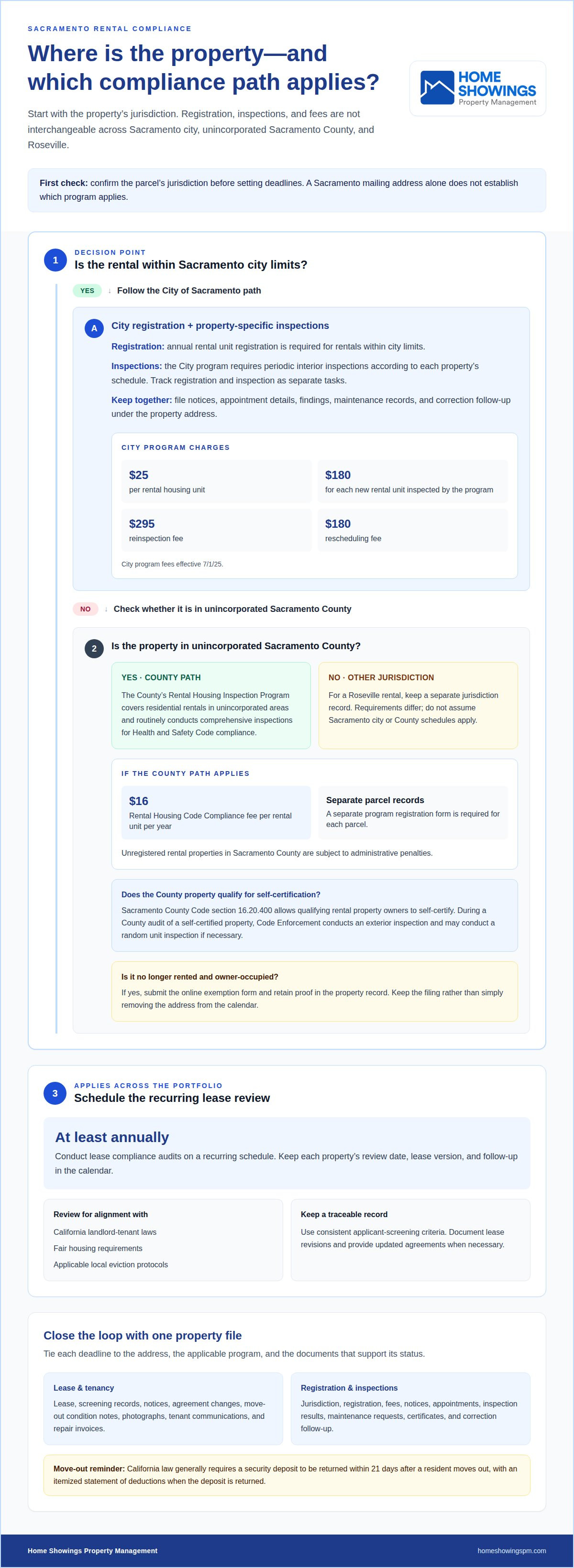
A Sacramento rental property compliance audit works best on a calendar, not just in response to a notice. Landlords and property managers should conduct lease compliance audits at least annually, and rental properties within Sacramento city limits require annual registration.
Managing several properties can mean tracking different registration, inspection, and lease-record dates across Sacramento and Roseville. Responsibilities can quickly feel scattered when inspections, maintenance records, and lease updates all need attention.
This guide shows you how to organize those tasks in one practical system. Learn how to track rental registration and inspection requirements, schedule recurring audits, and keep lease records together so you can see what is due and which documents support each property.
Table of Contents
How Can Sacramento Landlords Stay Organized With Multiple Compliance Deadlines?
Use a property-by-property calendar for lease reviews, registration, fees, and inspections. The schedule depends on whether a rental is within Sacramento city limits or in unincorporated Sacramento County.
Review Leases for ComplianceReview each lease and applicant-screening process on a recurring schedule. Check that lease terms align with California landlord-tenant laws, fair housing requirements, and applicable local eviction protocols. Apply the same screening criteria consistently to every applicant, and keep the criteria and related records together. For example, file the lease, screening records, notices, and later agreement changes under the property's record.When a lease changes, document the revision and provide tenants with updated agreements when necessary. Record the property, review date, lease version, and any follow-up in the calendar. This creates a traceable review history instead of relying on memory when a question arises.
Understand Rental Inspections and Audit ScopeIdentify the program covering each address, then record its inspection status and next action. Sacramento County Code section 16.20.400 allows qualifying rental property owners in Sacramento County to self-certify. During a County audit of a self-certified property, Code Enforcement conducts an exterior inspection and may conduct a random unit inspection if necessary.The County’s Rental Housing Inspection Program routinely and comprehensively inspects residential rentals in unincorporated areas for Health and Safety Code compliance. A Sacramento rental property compliance audit should bring together inspection notices, findings, maintenance requests, and certificates. Link each item to the property and any required correction or follow-up.
Track Fees and Inspection DatesRecord program charges beside each property’s registration and inspection dates. Sacramento County assesses a Rental Housing Code Compliance fee of $16.00 per rental unit per year, annually. The City of Sacramento’s Rental Housing Inspection Program charges $25 per rental housing unit, $180 for each new rental unit inspected by the program, a $295 reinspection fee, and a $180 rescheduling fee, effective 7/1/25.Create separate calendar entries for recurring charges and inspection appointments. A missed appointment or required reinspection can create another deadline and fee, so file notices and outcomes alongside the schedule. Unregistered rental properties in Sacramento County are subject to administrative penalties.
Build an Inspection Checklist and Record ExemptionsPrepare a property-specific checklist before an inspection. Include the appointment notice, prior findings, maintenance requests, compliance certificates, and records of completed corrections. For multiple parcels, Sacramento County requires a separate Rental Housing Inspection Program registration form for each parcel.If a Sacramento County property is no longer rented and is owner-occupied, submit the online exemption form and retain proof of exemption. Add the filing to the property record rather than simply removing the address from the calendar. A complete checklist makes the property’s status and next action easy to identify.
City rental registration and inspection requirements
Start by identifying the jurisdiction for each address. Sacramento city, unincorporated Sacramento County, and Roseville have different registration and inspection requirements, so don’t assume their schedules are interchangeable.
Confirm the property’s jurisdiction before setting its calendar. The City of Sacramento requires annual rental unit registration for rental properties within city limits. Its Rental Housing Inspection Program also requires periodic interior inspections according to each property’s schedule. Keep registration and inspection as separate tasks, with the records together. File each inspection notice under the relevant address, along with appointment details and any later findings.Sacramento County’s Rental Housing Inspection Program covers residential rental properties in unincorporated areas. A Sacramento mailing address alone doesn’t establish which program applies. Record the parcel’s jurisdiction to avoid assigning a City schedule to a County property. For a Roseville rental, maintain its own jurisdiction record rather than assuming Sacramento city limits apply.
Keep separate records for exterior and interior inspections. For the exterior, document visible conditions and date-stamped observations, then retain inspection notices and results. For the interior, organize property-specific inspection records, maintenance requests, and correction follow-up. Because the City program’s periodic interior inspection schedule is property-specific, link each notice to the address and scheduled visit instead of relying on a general calendar reminder.File each completed inspection record with related maintenance documentation. If a report identifies a condition requiring follow-up, record the action and retain supporting documents. This creates a clear history from notice to inspection and subsequent work without confusing a City inspection with a County one.
Document move-out condition and deposit accounting as separate records. Keep the move-out condition notes, photographs, tenant communications, and any repair invoices with that tenancy’s file. California law generally requires landlords to return a security deposit within 21 days after a resident moves out, according to the California Legislature. The landlord must also provide an itemized statement of deductions when returning the deposit.Use a dated file entry to connect the move-out record, deposit accounting, and itemized statement. This helps owners distinguish tenant move-out documents from government inspection records. Keep correspondence and supporting documents together so the accounting can be followed without searching unrelated property files.
Keep each property’s notices and inspection history accessible in one organized record. A structured property inspection process can help keep scheduled visits and resulting records connected to the correct rental. Separate folders or digital records by address, then sort notices, reports, and follow-up documents by date. That simple structure makes it easier to identify the next scheduled task and retrieve the record connected to a particular inspection.
Scheduling recurring audits and tracking documents
Use one property record and calendar to connect recurring reviews with their supporting documents. Landlords and property managers should conduct lease compliance audits at least annually.
Set a recurring annual lease-audit date for each property. When practical, schedule it before the lease renewal period to allow time to document changes and provide updated agreements when necessary. Record the reviewer, review date, and lease version. If a property has several active agreements, give each lease its own record rather than relying on one general reminder.After each review, note the issues identified and the action taken. A dated entry such as “revised agreement provided” creates a clearer history than an unlabeled file. Keep earlier versions too, so the record shows what changed and when.
Create a document index for every address. Include City inspection records, maintenance requests, compliance certificates, lease versions, and audit notes. Name files consistently using the property address, document type, and date. For example, label a maintenance request with the address and issue, then connect its completion record to the same file group.Keep the index separate from the documents themselves. It should show where each record is stored and whether follow-up remains. This is especially useful when several properties have similar inspection notices or maintenance concerns.
Link each inspection finding to its supporting documents and next action. If a report calls for a correction, save the notice, related maintenance request, completion record, and any follow-up inspection document together. Keep the action open until the file contains evidence that the step is complete. This prevents an old notice from appearing resolved just because a repair was discussed.Use the property calendar to show who is responsible and what happens next. A clear handoff matters when owners, tenants, and property managers share responsibilities. Keep the notice and follow-up record under the same address, not only in an individual’s inbox.
Track credentials that support inspection work alongside property records. The California Apartment Association provides County-approved self-certification training required for people conducting inspections on behalf of a Sacramento County rental property owner. The training certificate is valid for 5 years. Record its issue and expiration dates so the inspection file reflects whether the credential remains current.Store the certificate with the related inspection documents, not only in a personal file. If the person conducting inspections changes, update the responsibility record and retain applicable credential documentation.
Close each annual audit with a brief status summary. List the leases reviewed, open corrections, updated agreements, and documents still awaiting filing. Carry unresolved items into the next calendar entry instead of starting a fresh record. This summary gives owners a practical view of responsibilities across Sacramento and Roseville without replacing the underlying documents.
Why lease compliance audits matter in Sacramento and Roseville
Use an audit to connect each lease decision to the rules that apply to that property. Sacramento-area portfolios need property-level records, not assumptions based only on city names.
Schedule a lease compliance audit annually and record the review date and property address. Landlords and property managers should conduct lease compliance audits at least annually. For owners with rentals in Sacramento and Roseville, separate records help prevent a rule affecting one property from being applied automatically to another.During each review, identify the unit, current agreement, and decision being assessed. For example, file a rent-change review with that unit’s lease and notices. This gives managers a specific record to revisit when preparing a renewal or responding to a tenant question.
Review rent provisions against the rule that applies to each unit. California’s AB 1482 generally limits annual rent increases to 5% plus the local rate of inflation, and generally sets a maximum annual rent increase of 10%. It is currently in effect through January 1, 2030. Some rental homes are exempt from its rent cap when ownership and lease-notice conditions are met, although just-cause eviction protections may still apply.For covered Sacramento rental units, the Tenant Protection Program sets a maximum annual rent adjustment of 8.6%, effective July 1, 2026. Keep the program and date with the unit’s rent review rather than copying a single increase rule across a portfolio.
Flag properties that may fall under Measure Q for a separate review. Sacramento voters approved Measure Q in November 2024. It caps rent increases on covered pre-1995 multi-unit properties at the lower of 3% or 60% of the Sacramento-Roseville-Folsom CPI.That coverage description makes the property’s age and building type important audit details. Record why the unit is treated as covered or not covered, along with the lease and rent calculation used. Measure Q also requires two months’ rent in relocation assistance for certain no-fault evictions, so document reviews related to those decisions.
Track inspection-program oversight on the same property-level calendar. Sacramento County rental property owners approved for self-certification may be selected for random Code Enforcement audits. Keep the self-certification and any inspection findings together, then record resulting actions and dates.Self-certification does not eliminate the possibility of an audit. A clear record lets owners and managers see how a property’s stated condition connects to later findings, maintenance, and lease administration.
Use the completed audit to assign next steps, not just store a checklist. Note which lease, rent decision, or inspection record needs attention, who is responsible, and when the file should be reviewed again. For a Sacramento or Roseville portfolio, this property-by-property approach makes local differences visible and creates a useful history for future decisions.
What permits are required for rental property repairs, renovations, or unpermitted work in Sacramento?
Start with the planned work and the property’s location. These details help identify applicable permit requirements and records before repairs or renovations proceed.
Write a clear scope of work for the rental before planning the project. Separate routine maintenance from work that changes a system, layout, or building component. For example, describe whether the project repairs an existing feature or alters it. Include the address, affected area, materials, and work description so the permit review starts with specific details, not a broad label such as “renovation.”Keep the scope with the property file. If the work description changes, update the record before treating the original permit assessment as applicable.
Identify the property’s jurisdiction before reviewing permit requirements. A Sacramento address may fall within City of Sacramento limits or unincorporated Sacramento County, while Roseville is a separate location. Record the jurisdiction beside the project address to avoid relying on a permit assumption made for another property or local authority.Keep the jurisdiction record with the scope and project correspondence. If the rental includes multiple parcels, associate each parcel with its own project documents.
Review the work by category, not just by estimate. List affected structural elements, electrical or plumbing systems, heating equipment, and exterior features. For complex heating or ventilation systems, reviewing safety inspection protocols from specialists like PSP & Gas Engineering can provide useful insight into how flue and gas equipment should be documented. These examples help organize the questions a permit review needs to address, but they are not a permit determination. For each category, record whether the project repairs, replaces, or changes the existing feature.Keep the project description consistent across estimates, notices, inspection records, and completion documents. Different descriptions can make it harder to connect finished work with the original assessment.
For work already completed without permit records, assemble the available project history before scheduling more work. Gather invoices, contractor notes, photographs, prior inspection documents, and property-related correspondence. Record what changed and when, if those details are available. Don’t describe undocumented work as approved; keep verified records separate from estimates or recollections.Use the file to identify unresolved questions about the work and its documentation. A property inspection can record visible conditions, but it doesn’t replace a permit determination.
Close the project file only after recording the final scope, relevant permit documents, inspection outcomes, and maintenance follow-up. Keep these records with the property’s compliance documentation, not only with a vendor’s paperwork. For ongoing repair coordination, organize rental property maintenance alongside the property’s inspection and project records.
Permit requirements depend on the work and the property’s jurisdiction: City of Sacramento, unincorporated Sacramento County, or Roseville. Assess repairs, replacements, or changes to structural elements, electrical or plumbing systems, heating equipment, and exterior features separately. For completed work without permit records, gather the project history and identify unresolved documentation questions.
Home Showings Property Management: Rental Marketing
Home Showings Property Management connects rental marketing with the ongoing work of managing a residential rental. When compliance deadlines compete with preparing a vacancy, reviewing applicants, or organizing rent collection, coordinated property management can help keep responsibilities in view.
Rental marketing presents a vacancy to prospective tenants, while tenant screening supports a consistent applicant review process. Rent collection is part of the ongoing rental operation. These services complement an owner’s records and compliance calendar; they don’t replace property-specific registration, inspections, or lease reviews.
If you’d like support with your rental, contact Home Showings Property Management.
Make the Next Review Part of Your Operating Rhythm
Use your next Sacramento rental property compliance audit as a practical planning point. Decide who is responsible for each follow-up, which records need updating, and how the next review fits the property’s operating schedule. A clear process helps keep compliance work from becoming a last-minute interruption to leasing and tenant communication.
If managing a rental also means coordinating its marketing and day-to-day responsibilities, Home Showings Property Management offers support through property management, rental marketing, and tenant screening. Choose the level of help that fits your needs, while keeping property-specific compliance decisions and records visible in your own management process.
Contact Home Showings Property Management to discuss support for your rental. A steady process starts with one clear next step.
Frequently Asked Questions
What Records Should Sacramento Landlords Keep for Their Rental Property?
Keep a separate, searchable file for each rental address. Include signed leases, amendments, notices, applicant-screening records, rent-change documentation, inspection reports, and maintenance correspondence. For example, connect a repair request to its completion record and any related inspection note. Also retain rental registration and exemption documents where applicable. Label files by property, document type, and date so you can retrieve the record supporting a decision without searching unrelated tenant or property files.
What Should Sacramento Landlords Do When Local and State Rules Conflict?
First, identify the rule, property, and decision involved rather than treating every requirement as interchangeable. Review the lease against California landlord-tenant laws and the local eviction protocols that apply to the property. Record the jurisdiction and the lease clause being reviewed. If the issue concerns a rent adjustment or eviction, keep supporting notices and calculations with the relevant unit’s file instead of applying one portfolio-wide assumption.
What rental property inspections and compliance rules apply in Sacramento, California?
Requirements depend on whether the property is within Sacramento city limits or in unincorporated Sacramento County. The City requires annual rental unit registration and periodic interior inspections according to each property’s schedule. The County program covers residential rentals in the unincorporated area, and qualifying owners may self-certify under Sacramento County Code section 16.20.400. Keep the property’s jurisdiction, registration, inspection notices, and resulting records together to distinguish the applicable program.
Does Sacramento require rental property registration or a business license?
Rental properties within Sacramento city limits require annual rental unit registration. Keep the registration record separate from any business-license records associated with the ownership or operating entity, so one document isn’t mistaken for another. For Sacramento County properties, registration with the Rental Housing Inspection Program matters because unregistered rentals are subject to administrative penalties. Record the property’s jurisdiction and parcel information with its registration documents.
What California habitability standards must Sacramento rental properties meet?
Sacramento County’s Rental Housing Inspection Program checks residential rentals in the unincorporated area for compliance with Health and Safety Code requirements. Properties that fail minimum health and safety requirements receive a Notice of Violation and a correction date for re-inspection. Keep the notice, correction records, and follow-up inspection documentation together. The City of Sacramento also has periodic interior inspections, scheduled according to each property’s inspection schedule.
What are the costs of a Sacramento rental property compliance audit?
Program fees depend on jurisdiction and inspection event, rather than one uniform audit charge. Sacramento County assesses a Rental Housing Code Compliance fee of $16.00 per rental unit per year, annually. The City program charges $25 per rental housing unit, $180 for each new rental unit inspected, a $295 reinspection fee, and a $180 rescheduling fee, effective 7/1/25. Keep each charge tied to its property and program record.
What are the penalties for rental housing code violations in Sacramento?
In Sacramento County, rental properties not registered with the Rental Housing Inspection Program are subject to administrative penalties. When violations are found, the County may also apply cost recovery fees. A property failing minimum health and safety requirements receives a Notice of Violation and a correction date for re-inspection. Save the notice and document each corrective action, so the property file shows the response connected to the specific finding.
How can landlords prepare a Sacramento rental property for a compliance audit?
Organize the property file before an audit notice or scheduled inspection arrives. Gather City inspection records, maintenance requests, compliance certificates, registration documents, and current lease records. Connect each prior finding to its completed correction or follow-up record. For a County self-certified property, remember that Code Enforcement conducts an exterior inspection and may conduct a random unit inspection if necessary. Keep records easy to retrieve by address.

Comments