
Folsom landlord guide to local ordinances for rent and use

Folsom has no local just-cause eviction ordinance, but that doesn’t mean every rental can be ended without a reason. For covered rentals, AB 1482’s just-cause protections generally apply after at least 12 months of tenancy, according to the California Legislature. In this Folsom landlord guide to local ordinances, the key distinction is between city rules and statewide protections.
It’s understandable to want a clear answer before changing rent, ending a tenancy, or using a property differently. This guide explains how rent limits and notice rules work, when no-fault eviction assistance may apply, and what California requires for security deposits.
You’ll also find a practical overview of Folsom’s rules for permitted property uses, including vacation rentals and accessory dwelling units. Separating local requirements from state rules can help you identify what may affect your property and where careful management can keep rental operations organized.
Table of Contents
How much can my landlord raise my rent in Folsom?
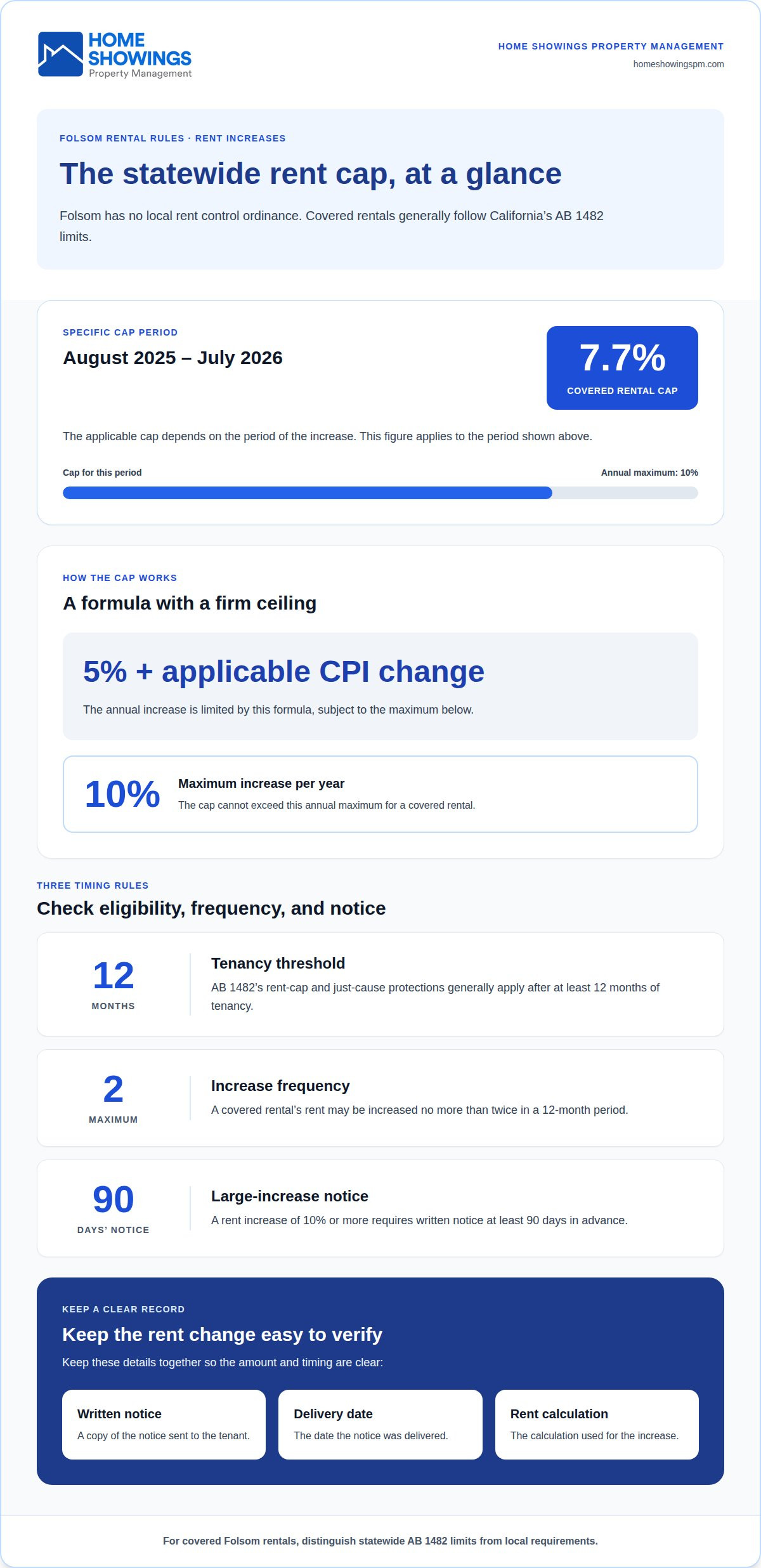
Folsom has no local rent control ordinance, so covered rentals generally follow California’s AB 1482 limits. This Folsom landlord guide to local ordinances separates that state rent cap from other local requirements. The cap is 5% plus the applicable CPI change, with a maximum increase of 10% per year. A covered Folsom rental’s cap was 7.7% for August 2025 through July 2026; the applicable cap depends on the period of the increase.
AB 1482 generally requires at least 12 months of tenancy before its rent cap and just-cause protections apply, according to the California Legislature. The law also limits increases on a covered rental to twice in a 12-month period. A rent increase of 10% or more requires 90 days’ written notice. Keep the notice, its delivery date, and the rent calculation together, so the timing and amount are clear.
Rent is only one part of a landlord’s compliance calendar. California disclosure requirements can affect lease preparation, especially for older buildings or properties with specific hazards. Before a lease begins, provide required disclosures, including:
Lead-based paint information for properties built before 1978.
Asbestos disclosure for buildings constructed before 1979.
Notice of a non-HIV/AIDS-related death in the unit within the last three years.
Notice when the property is within one mile of military ordnance, if applicable.
Folsom business license certificates expire every June 30, and renewal payment is due by July 31. The city council sets the business license tax rate annually each April. If a rental activity requires a business license, record those dates alongside lease and rent review dates rather than treating renewal as a one-time task.
Parking can also depend on the property’s location and development rules. In the Folsom Boulevard Special Planning Area, parking must meet Title III, Chapter 30, of the Sacramento County Zoning Code. That rule is area-specific; it should not be treated as a citywide parking standard for every Folsom rental. A useful Folsom landlord guide to local ordinances distinguishes these location-specific provisions from statewide rent rules.
Smoke and carbon monoxide alarms and fire-safety conditions are separate from rent calculations. Requirements depend on the dwelling and applicable safety rules, so include them in your property’s safety and maintenance planning.
If you believe an ordinance has been violated, organize the relevant lease, notices, and communications, then follow the applicable City of Folsom complaint process. Any penalty depends on the specific violation and ordinance.
Consult the Folsom Municipal Code and the city’s official rental guidance for current local rules. If your property is in a special planning area, review the applicable development and parking provisions as well.
Permitted commercial and residential uses
Folsom’s permitted uses depend on the property’s zoning and any special planning-area rules. In the Folsom Boulevard Special Planning Area, commercial uses are those allowed in the Sacramento County Limited Commercial zone under Sections 225-11 and 225-14. Residential uses follow the RD-20 zone provisions in Sections 201-02 and 201-04. Those references help distinguish an allowed use from one requiring a separate permit.
Some activities have specific permit conditions. A financial institution in the special planning area may have a single drive-service window only with a use permit from the Project Planning Commission. Events such as weddings or fundraisers treated as bed and breakfast inn activity require a conditional use permit under Folsom Municipal Code Chapter 17.27. A property’s existing residential use doesn’t automatically authorize a different business or event use.
Short stays have their own rules. Folsom defines a vacation rental as a furnished apartment, house, or condominium rented for less than 30 days. The municipal code limits a vacation rental to three paying guests in a dwelling. The city has no citywide cap on the number of short-term rentals and doesn’t require operators to live at the property. These points don’t remove other applicable restrictions.
For vacation rentals, Folsom’s transient occupancy tax is 8% of gross receipts for stays of 30 consecutive days or less. Returns and payments are due within 60 days after each quarter closes. This tax treatment is distinct from the city’s definition of a vacation rental, which uses a stay of less than 30 days. A common interest development may also prohibit rentals of 30 days or less under California law.
Accessory dwellings follow a different minimum rental period. Folsom requires an accessory dwelling unit or junior accessory dwelling unit to be rented for at least 30 days. That makes the unit’s classification important: a furnished unit rented for a shorter stay may fall under vacation-rental rules instead. Before setting occupancy terms, identify the unit type and intended rental period.
Development standards can also shape what changes are allowed. Folsom Ordinance No. 1375 re-adopts Ordinance 1353, amending Chapter 17.52 for the Historic District. The amendment addresses development standards and review levels for design review, sign permits, demolitions, and accessory buildings. A change involving a historic property may therefore require attention beyond its proposed use.
For a planned residential tenancy, residential leasing support can help organize the rental process around the property’s intended use and occupancy terms.
Security deposit limits and returns
For a Folsom rental, California rules set the general security deposit limit at one month’s rent. Keep the deposit separate from rent increases, and record each amount clearly in the lease and payment ledger. If rent changes during a tenancy, track the deposit and rent history separately rather than treating the deposit as an automatic adjustment.
California landlords must return a tenant’s security deposit within 21 days of move-out, according to the California Legislature. The deadline makes move-out date tracking essential. Record when the tenant returns possession, then schedule the condition review and accounting promptly enough to complete the return within that period.
Deductions must be reasonable, properly documented, and made in good faith. The amount withheld should be clearly connected to the property’s condition or a documented expense. Avoid relying on a vague note such as “cleaning” or “repairs”; retain specific records explaining the decision.
A consistent file makes the accounting easier to understand. Keep the signed lease, deposit receipt, move-in condition notes, dated photographs, move-out inspection notes, and relevant invoices or receipts together. For example, a move-out photo that shows a different condition from the move-in record can help explain what changed. Records should support the actual deduction, not merely be present in the file.
Use a repeatable move-out process for every Folsom tenancy:
Record the move-out date and the date possession is returned.
Document the unit’s condition with written notes and photographs.
Match each proposed deduction to supporting records and a reasonable amount.
Calculate the remaining deposit and arrange its return within 21 days.
Clear communication matters, too. A concise accounting helps the tenant understand how the original deposit was handled. Keep a copy of the accounting and proof of the return with the tenancy record. If there are no deductions, document that and retain the return record. If deductions apply, avoid combining unrelated costs into one unexplained total.
For example, a property file might show the original deposit, move-out date, inspection notes, photographs, and receipts supporting a deduction. Together, those records create a traceable explanation rather than a number without context. The same organized approach supports consistent handling across multiple units and makes the 21-day deadline easier to manage.
Security deposit compliance involves more than the cap or return date. Each deduction must also be reasonable, supported, and made in good faith. Reliable recordkeeping gives each decision a clear basis and helps keep deposit handling consistent from move-in through the final accounting.
Annual rent increase caps and CPI
This Folsom landlord guide to local ordinances treats the AB 1482 rent cap as a period-specific calculation, not a permanent rate. For rentals covered by the law, California’s annual limit combines a fixed percentage with the applicable CPI change. The formula is 5% plus that CPI change, subject to a maximum increase of 10% per year. CPI reflects changes in consumer prices, so the allowable amount can vary between annual periods. Folsom has no local rent-control ordinance setting a separate citywide cap.
The applicable rate depends on the period being assessed. For August 2025 through July 2026, the AB 1482 cap for covered Folsom rentals was 7.7%. The 2025 California statewide CPI increase was approximately 2.7%. Adding 5% and 2.7% produces 7.7%, below the law’s 10% annual maximum. These figures illustrate the calculation for that period, not a fixed rate for every year.
To apply the cap, first determine whether AB 1482 covers the unit. As of 2026, units with certificates of occupancy issued in 2011 or later are not covered by AB 1482. That construction-related exemption can change which rent-limit rules apply. A unit’s age alone is not the stated test; the certificate-of-occupancy date is the relevant detail.
California’s Costa-Hawkins restrictions also matter when considering local rent control. The construction-date cutoff described for those restrictions is February 1, 1995. This is separate from calculating the AB 1482 cap. Keep the property’s construction and occupancy records distinct, since each date may relate to a different legal question.
A practical rent review should record the relevant period and calculation together. For example, an owner reviewing a proposed increase for the August 2025 through July 2026 period can compare the planned percentage with the 7.7% cap, if the unit is covered. The record should identify the CPI period used, the fixed 5% component, the resulting total, and whether the 10% maximum applies.
Because CPI changes, reusing last year’s percentage can produce an incorrect result. For a useful Folsom landlord guide to local ordinances, match the proposed increase date to the applicable CPI period and organize the property’s coverage information. Keep the calculation with the rent history. This creates a clear record of how the proposed amount was reached and distinguishes a capped increase from a unit outside AB 1482’s coverage.
What habitability, building safety, and housing code standards must Folsom landlords meet?
Folsom’s housing standards combine local code provisions with adopted building codes. The city adopted the Uniform Building Code, Uniform Electrical Code, Uniform Plumbing Code, and Uniform Mechanical Code as secondary codes, subject to modifications or deletions in the Folsom Municipal Code. This qualification matters: a local municipal-code rule may alter a secondary-code provision.
For landlords, habitability and safety are ongoing property responsibilities, not just lease-start considerations. A building component, electrical issue, plumbing problem, or mechanical-system concern may involve different code provisions. The applicable standard depends on the condition and relevant code. Treating every repair as the same type of issue can obscure which system needs attention.
California landlords must enact repairs within 30 days of being notified. That period makes clear records useful from the first report through completion. A maintenance log can capture the date a tenant reports a condition, what was reported, follow-up communications, work arranged, and when the repair is completed. For example, a plumbing report and an electrical report should have separate entries.
A practical review connects tenant reports with property conditions. Organize recurring checks around the building’s key systems, and record concerns and repair outcomes. A useful property record can include:
The date and nature of each reported condition.
The affected area or system, such as plumbing or electrical equipment.
Actions taken, communications, and repair completion details.
Any relevant Folsom Municipal Code modification or deletion identified for the issue.
Folsom’s code structure matters when a general building-code provision and a local rule appear to address the same condition. The city’s adopted codes are secondary and subject to municipal modifications or deletions. Keep the code provision and relevant local change together in the property file. This gives you a clearer basis for understanding which standard applies to a particular repair.
Repair timing also requires attention to the report date. A tenant’s notice starts the timeline described for repairs, so recording when the notice arrives helps track the 30-day period. A written entry should identify the concern without assuming its cause. If an initial report concerns a mechanical system, for instance, record the reported symptoms and subsequent repair information separately.
For a more organized approach to maintenance oversight, coordinate property maintenance and keep repair records connected to the relevant building systems and Folsom code requirements.
Home Showings Property Management
Home Showings Property Management helps rental owners organize the ongoing work of a residential tenancy. When local requirements affect leasing, rent collection, or property upkeep, consistent records and clear processes keep decisions connected to the property and its tenancy. Our Property Management service coordinates key parts of the rental process, while Rental Marketing and Tenant Screening help prepare a home for occupancy. Rent Collection keeps payment records organized alongside lease information.
This support can be useful when managing notices, tenant communications, rent records, and maintenance needs becomes difficult to track across a property. Contact Home Showings Property Management to discuss support for your rental.
Build a steadier rental routine
Use this Folsom landlord guide to local ordinances as a starting point for informed decisions, then build consistent property-management habits around them. Recording important dates, communications, and property matters can make each tenancy easier to oversee and provide a useful reference when circumstances change or you revisit an earlier decision.
Good rental operations develop through steady attention, not a single review. Choose a recordkeeping approach that works for your property, keep information organized, and make time to revisit your procedures as your needs evolve. With a reliable routine in place, you can focus on thoughtful decisions and a well-managed rental.
For support with your rental, contact Home Showings Property Management. Take the next step with a clear plan and move forward with confidence.
Frequently Asked Questions
Can my landlord evict me without cause in Folsom?
It depends on whether California’s just-cause protections cover the rental. Folsom has no local just-cause eviction ordinance, but AB 1482 protections may apply after the required tenancy period. For a covered rental, an owner-move-in or qualifying substantial remodel may be treated as a no-fault reason, with relocation assistance requirements. A tenant facing an eviction notice should distinguish the stated reason from whether the property and tenancy fall under state protections.
Does AB 1482 apply to my rental in Folsom?
AB 1482 applies to covered rentals, not every Folsom property. As of 2026, units with certificates of occupancy issued in 2011 or later are not covered by the law. For covered rentals, the California Legislature states that at least 12 months of tenancy generally must pass before the rent cap and just-cause protections apply. The unit’s certificate date and tenancy history are key details for assessing coverage.
Does Folsom have local rent control?
No. Folsom has not enacted a local rent-control ordinance. That doesn’t remove statewide limits: AB 1482 may still cap increases for covered rentals, depending on the unit and tenancy. The construction-date cutoff described for Costa-Hawkins restrictions on local rent control is February 1, 1995. Owners should keep that issue separate from determining whether a particular unit falls under AB 1482.
Quick answer: Are short-term rentals legal in Folsom?
Folsom allows vacation rentals subject to city rules, but a property’s zoning and other restrictions still matter. The city defines a vacation rental as a furnished apartment, house, or condominium rented for less than 30 days, and its code limits occupancy to three paying guests in a dwelling. A common interest development may prohibit rentals of 30 days or less under California law, adding another restriction to consider.
What Are Short Term Rental (Airbnb, VRBO) Regulations In Folsom, California?
Folsom has no citywide cap on short-term rental numbers and doesn’t require operators to live at the property. Vacation rentals are limited to three paying guests per dwelling. The city’s transient occupancy tax is 8% of gross receipts for stays of 30 consecutive days or less. Returns and payments are due within 60 days after each quarter closes. A homeowners association’s rules may also restrict short stays.
What rental housing ordinances apply to landlords in Folsom, California?
Applicable rules can involve zoning, allowed uses, rental periods, property safety, and local development standards. For example, Folsom requires accessory dwelling units and junior accessory dwelling units to be rented for at least 30 days. In the Historic District, Chapter 17.52 addresses standards and review levels for matters such as design review, signs, demolitions, and accessory buildings. The property’s location and intended use shape which local provisions matter.
Does Folsom have local rent control or limits on rent increases?
Folsom has no local rent-control ordinance, but AB 1482 sets a state limit for covered rentals. The annual cap is 5% plus the applicable CPI change, with a maximum increase of 10% per year. For context, the cap for covered Folsom rentals was 7.7% from August 2025 through July 2026. That historical rate doesn’t establish the cap for a different annual period.
What just-cause eviction rules apply in Folsom, and how do they interact with California law?
Folsom has no local just-cause ordinance, so California’s AB 1482 protections are important for covered rentals. The California Legislature states that protections generally begin after at least 12 months of tenancy. For a covered no-fault eviction, relocation assistance equals one month’s rent, or the landlord may waive the final month’s rent. A substantial remodel used as a no-fault reason must involve work lasting more than 30 days.
Comments