
Elk Grove rental property tenant screening red flags

Consistent screening matters more than reacting to a single red flag. For Elk Grove rental property tenant screening, review eviction records and speak with former landlords, not just the current one. Consider the full rental history and the circumstances behind any filing. A past eviction deserves careful attention, but it should not replace a consistent review of the entire application.
It’s understandable to focus on credit or income when choosing a tenant, but neither tells the whole story. This guide explains how to review rental history, weigh credit and income, and apply the same screening criteria to every applicant. You’ll also learn how to keep decisions aligned with fair housing and adverse action requirements, making the process thorough, consistent, and easier to explain.
Table of Contents
1. How can landlords check for past evictions?
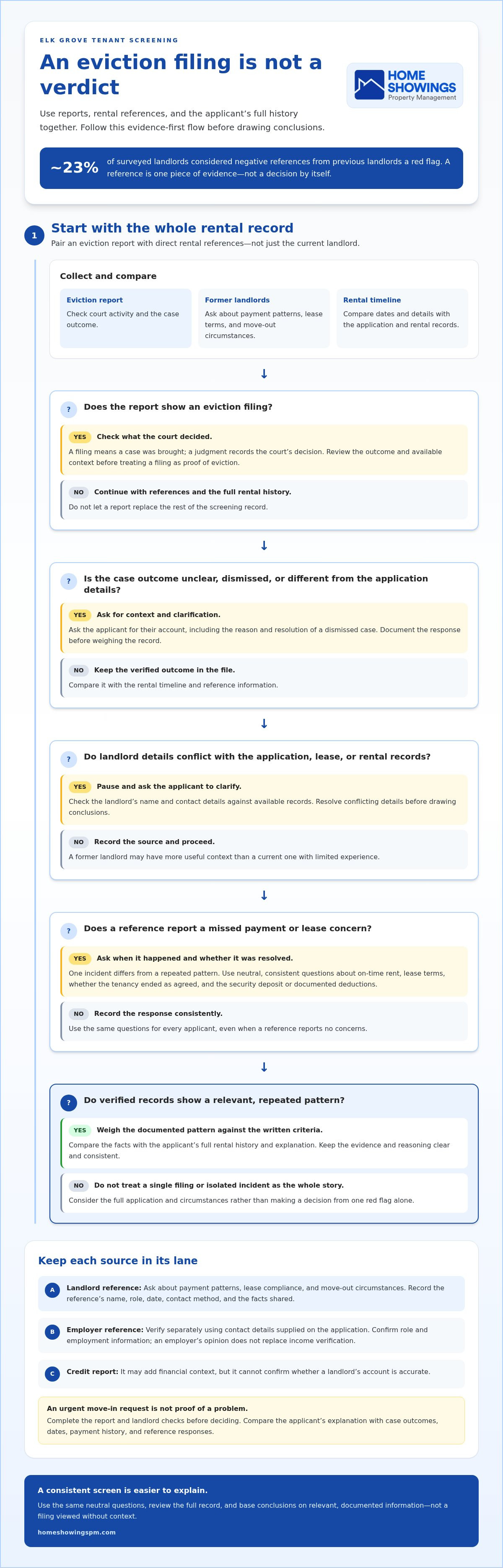
To assess Elk Grove rental property tenant screening red flags, pair an eviction report with direct rental references. The report may show court activity, while former landlords can describe payment patterns, lease compliance, and move-out circumstances. Neither source should stand alone. Compare the information with the applicant’s rental timeline, then ask focused questions about gaps or conflicting details.
In California, distinguish an eviction filing from a judgment: a filing shows that a case was brought, while a judgment records the court’s decision. Review the case outcome and available context before treating a filing as proof of eviction. A dismissed case may warrant questions, but its reason and resolution matter. Ask the applicant for their account and document the response.
Start with the rental history on the application. Contact a former landlord, not just the current one, who may have limited experience with the tenant or may want them to leave. Compare the landlord’s name and contact details with the lease, rental records, or other application information. If details conflict, ask the applicant to clarify before drawing conclusions.
Nearly 23% of landlords surveyed considered negative references from previous landlords a red flag. Use the same questions for each applicant: Were rent payments on time? Did the tenant follow lease terms? Did the tenancy end as agreed? Ask whether the security deposit was refunded and whether any deductions reflected documented issues. Record the reference’s answers consistently.
Keep questions specific and neutral. Ask, “Did the tenant leave before the lease ended?” or “Were rent payments made according to the agreement?” If a landlord reports a missed payment, ask when it happened and whether it was resolved. One incident differs from a repeated pattern. Record the reference’s name, role, date, contact method, and the facts shared.
Verify employment references separately from landlord references. Contact the employer using details supplied on the application, and confirm the applicant’s role and employment information. An employer’s opinion does not replace income verification. A credit report may provide financial context, but it cannot confirm whether a landlord’s account is accurate. Use each source only for the criteria it can address.
If an applicant is rushing to move, complete the eviction report and landlord checks before making a decision. Urgency alone does not establish a problem. Compare the applicant’s explanation with case outcomes, dates, payment history, and reference responses. Elk Grove rental property tenant screening red flags should be supported by relevant, consistent records, not a filing viewed without context.
2. What about a tenant’s credit score?
Credit score is one signal, not a complete measure of whether an applicant will pay rent. For Elk Grove rental property tenant screening red flags, review the score alongside the report’s payment history and the applicant’s other qualifications. Common screening benchmarks include 620 or higher and 650 or higher, but neither is a universal pass-or-fail rule. One suggested scale categorizes 700+ as low risk, 650-699 as moderate risk, and below 650 as high risk.
Look beyond the credit score. Review payment behavior, outstanding debt, and whether missed payments are isolated or repeated. A renter with a lower score after one resolved setback may present a different picture from someone with repeated late payments across several accounts. Compare those patterns with rental history and documented income instead of letting one number decide.
California application fees and security deposits are subject to separate state rules. Apply the relevant limits to each charge, and do not use a larger deposit to offset credit concerns. Keep credit reviews tied to written screening criteria rather than changing conditions for an individual applicant.
Frequent moves deserve follow-up, not automatic rejection. Investigate if an applicant lists more than 3 previous addresses in the past 5 years. Someone who lived in 4 places in 3 years can explain whether work, family needs, or lease changes drove those moves. Compare the explanation with the dates and rental history in the application.
A high-pressure move-in request can make a careful process feel rushed. An applicant might seek an immediate decision or offer to skip a credit check. Just over 17% of landlords surveyed considered an objection to a credit check a significant red flag. Ask why the applicant objects, explain that the same screening steps apply to everyone, and document the response. Urgency alone doesn’t prove a problem.
Property managers can support a consistent process by verifying the applicant’s identity and obtaining required permission before requesting a credit report. Use the same criteria for every renter, and ask about relevant discrepancies before relying on them. When reviewing Elk Grove rental property tenant screening red flags, distinguish a verified concern from an unexplained assumption about the applicant.
Consider the score alongside rent affordability, not as a substitute for it. A strong score cannot establish current income, while a lower score may not explain a reliable record of housing payments. Keep those questions distinct and document the credit factors considered. This makes Elk Grove rental property tenant screening red flags easier to assess consistently across applications.
3. What’s more important: credit history or income?
Credit history and income answer different screening questions. A credit report shows past borrowing and payment behavior; income checks help estimate whether rent fits the applicant’s current finances. Compare both with rental history and written criteria. A strong score cannot prove current affordability, and high income alone cannot erase repeated missed payments.
More than 45% of landlords surveyed considered insufficient income or inconsistent employment a tenant-screening red flag. A common benchmark is income of at least three times the monthly rent. Treat that as a screening measure, not a complete affordability calculation. Consider the documented income, its reliability, the rent amount, and recurring obligations shown in the application.
Verify income using two to three recent pay stubs, then compare their dates, pay periods, and totals with the rental application. Ask for clarification if the stated salary differs from the documents. For hourly or variable work, review the pay history across 2-3 months to understand fluctuations rather than relying on one unusually high paycheck.
Check documents for inconsistencies before relying on them. Warning signs can include mismatched fonts, cut-off sections, misaligned text or figures, blurred logos, rounded salary amounts, and incorrect math. For example, if a pay stub’s gross pay does not match its listed hours and rate, ask the applicant to explain the discrepancy and provide clear supporting records.
Employment stability matters, but a gap needs context. Confirm the employer and the applicant’s role using contact details supplied on the application. If employment dates conflict, ask about the timeline and compare the answer with income records. A guarantor or co-signer may be considered if a gap affects the income assessment, using the same criteria applied to comparable applicants.
Credit behavior can add context to income. Repeated late payments may suggest budgeting pressure, while a single resolved issue may have a different explanation. Assess the pattern alongside current earnings and rent obligations. Do not treat debt alone as proof that an applicant cannot pay; determine whether documented income supports the proposed rent.
Keep unrelated screening issues separate. A criminal background report does not establish income reliability, and neither a credit score nor an employment gap proves a risk of property damage. Record evidence relevant to each criterion, then make decisions using the same process for every applicant. This keeps screening focused on demonstrated ability and rental-related history.
4. Fair Housing and adverse action requirements
In California, ask questions tied to rental qualifications, such as income, rental history, and payment behavior. The Federal Fair Housing Act prohibits discrimination based on race, color, national origin, religion, sex, familial status, or disability. The Fair Housing Act also bars a blanket policy rejecting every applicant with a criminal record.
Fair housing compliance begins before an application arrives. Set screening criteria around the tenancy, such as documented ability to pay rent, prior lease performance, and credit-report information. Then apply those standards consistently. A genuine red flag is relevant evidence, not a substitute for a fair review of the applicant’s full background.
Keep questions focused on rental-related facts. Ask where an applicant rented, whether rent payments were made as agreed, and whether a previous lease ended early. You can also ask about income verification and request the same supporting documents from each applicant. Avoid questions about protected characteristics or family circumstances unrelated to the stated rental criteria.
Review criminal background information individually. Do not use a blanket rule that automatically denies every applicant with a record. Consider the nature and recency of the record, its relevance to tenancy, and the applicant’s circumstances. Apply the same approach to each application, and document how the evidence relates to your written criteria.
Under the Fair Credit Reporting Act, a landlord who denies an applicant or adds conditions based on a credit report must provide a formal Adverse Action Notice. If a report leads to denial or added conditions, provide the required notice rather than relying only on a phone call. Keep a record of the report’s role in the decision and the notice provided.
If an applicant asks why you declined the application, give a legitimate reason tied to the screening decision. State the relevant criterion and the information considered, such as verified rental history or credit-report findings. Avoid vague explanations that could appear inconsistent with the standards used for other applicants. Clear records help show that the decision followed the same process.
Before approving or denying an application, compare the file with the criteria used for every other applicant. Check that you requested the same documents, applied the same standards, and provided the required notice for any adverse action based on a credit report. A consistent record helps distinguish a tenancy-related concern from a decision influenced by bias.
5. Consistent, criteria-based tenant screening
Write screening criteria before reviewing applications, then apply them to every applicant. Use the same standards for rental history, income, credit history, and background checks. A written process helps distinguish an actual warning sign from a gut reaction. For example, decide how to assess repeated late payments before comparing applicants, rather than changing the standard after seeing a credit score.
Make the criteria specific enough to guide decisions. State which documents support income, what rental history you’ll review, and how you’ll assess a credit report. Avoid vague rules such as “good renter” or “stable background,” which leave room for inconsistent judgments. If you consider a criminal record, define how you’ll assess its relevance instead of using a blanket exclusion.
Give applicants the written selection criteria and collect a signed acknowledgment confirming receipt. The Fair Credit Reporting Act guide recommends obtaining the applicant’s signed written consent before running credit and background reports. Keep the criteria, acknowledgment, consent, application, and reports together in the file. This record lets you compare the actual decision with the standards used for other applicants.
Use the same application fields for each renter. Request two to five years of residential history, then check for missing landlord details, unexplained gaps, or contradictory dates. If an applicant lists one address on the application but another on a supporting document, ask for clarification and record the answer. Do not treat a correctable omission as proof of dishonesty without checking the facts.
A simple decision record can keep the review consistent. For each criterion, note the information considered, whether it met the stated standard, and any explanation received. If one applicant’s credit history falls below a threshold, record the same factors you would review for another applicant with a similar score. Keep personal impressions separate from evidence such as payment records or verified references.
Before approval or denial, compare the completed file against the written criteria. Check that each required document was reviewed and that any exception has a clear, consistent reason. If a credit report leads to denial or added conditions, follow the applicable adverse-action process. For support putting a consistent screening process in place, get help with rental screening.
Home Showings Property Management: Property Management
Home Showings Property Management provides property management for owners who want support coordinating rental responsibilities. Its tenant screening service can help manage this part of the leasing process, while rental marketing supports reaching prospective renters and rent collection helps manage payments after a tenancy begins.
These services can be useful when you want screening and ongoing rental tasks managed as part of a broader property management arrangement. Clear criteria still matter: screening decisions should reflect relevant information and follow fair housing requirements. Contact Home Showings Property Management to discuss property management for your rental.
Build a Screening Process You Can Stand Behind
Make tenant screening part of a broader plan for your rental. Applying consistent standards to Elk Grove rental property tenant screening red flags can help you make decisions with a clear record instead of relying on pressure or instinct. Review your criteria periodically and keep each applicant’s file organized so the process remains practical as your property needs change.
If you’d like support coordinating that work, Home Showings Property Management offers Property Management, Rental Marketing, and Tenant Screening. These services can help owners bring applicant review into a more structured approach to managing a rental. A conversation can help you explore what fits your property and priorities. Contact Home Showings Property Management to discuss the next step for your rental.
Frequently Asked Questions
How can landlords check for past evictions?
Combine an eviction report with a review of the case outcome and the applicant’s explanation. In Elk Grove, match report details to the applicant’s identity and rental timeline before drawing conclusions. A filing alone does not establish that a court entered judgment. If the record seems inconsistent, ask the applicant about the specific case and note how the answer fits the rest of the application.
How can you tell if tenant documents are legitimate?
Compare documents with one another instead of judging a page in isolation. Check that names, dates, pay periods, and totals align across the rental application and supporting records. Inconsistent fonts, cut-off sections, misaligned figures, blurred logos, rounded salary amounts, or incorrect calculations warrant clarification. For example, ask the applicant to explain a mismatch between listed hours and gross pay before treating it as evidence of falsification.
What If You Need to Say No?
Base a denial on a documented screening criterion and information relevant to that standard. If a credit report influenced the denial or added conditions, the Fair Credit Reporting Act requires a formal Adverse Action Notice. Keep the decision record and notice with the application file. If asked, give the applicant a legitimate reason for the decision, such as a specific unmet rental qualification, rather than a vague personal impression.
What about a tenant’s credit score?
Use the score as one part of the application, not as a stand-alone verdict. Common screening benchmarks include 620 or higher and 650 or higher, while one suggested scale places 700+ in its low-risk category. These benchmarks differ, so choose a threshold in advance and apply it consistently. Review the report’s payment patterns and current obligations to understand what may sit behind the score.
What are the top tenant screening questions?
Ask questions that relate directly to the tenancy and apply them consistently. Useful prompts include: “Can you confirm your rental dates?” “What led to your last move?” “Were any rent payments made late?” and “May we contact the references listed?” For income, ask how the applicant’s documented earnings are structured. In Elk Grove, use the same questions and follow-up process for every applicant to keep comparisons fair.
What makes a great tenant?
A strong applicant presents a consistent, verifiable picture across the application, rental record, and financial documents. Look for reliable payment behavior, clear communication, complete information, and income that supports the rent. A good applicant also explains discrepancies directly rather than leaving conflicting dates or records unresolved. Assess these qualities against written standards, not personal assumptions or a preference for applicants with similar backgrounds.
What’s more important: credit history or income?
Neither matters in isolation: income indicates current capacity, while credit history offers clues about past payment behavior. Consider how they fit together. For instance, steady documented income may support rent affordability even if a credit report shows an older problem. Repeated payment trouble can still matter despite strong earnings. Compare both factors with rental evidence and apply the same weighting to every applicant.
What credit report issues are meaningful red flags for prospective tenants?
Repeated nonpayment and a pattern of late payments deserve closer review because they may relate to future rent reliability. Examine frequency, recency, and whether the applicant has resolved the accounts, rather than reacting to one entry alone. Ask about unfamiliar accounts or errors before relying on them. A credit concern carries more weight when it aligns with other verified application information.



Comments