
Elk Grove rental property market analysis for owners

An Elk Grove rental property market analysis also shows rents were unchanged month to month but down 0.8% year over year, a reminder that local conditions can shift even when the broader picture looks steady.
For owners, setting rent is only part of an Elk Grove rental property market analysis. Neighborhood appeal, likely renter needs, household income, and employment context all shape demand and how a home competes.
This overview brings those factors together to support better-informed decisions. You’ll see how rents have changed, what distinguishes Elk Grove neighborhoods, how income and employment relate to renter demand, and how local rents compare nationally. A citywide figure is a useful starting point, but it cannot replace an assessment of a home’s size, location, and appeal to prospective tenants.
Table of Contents
Household income and local employment
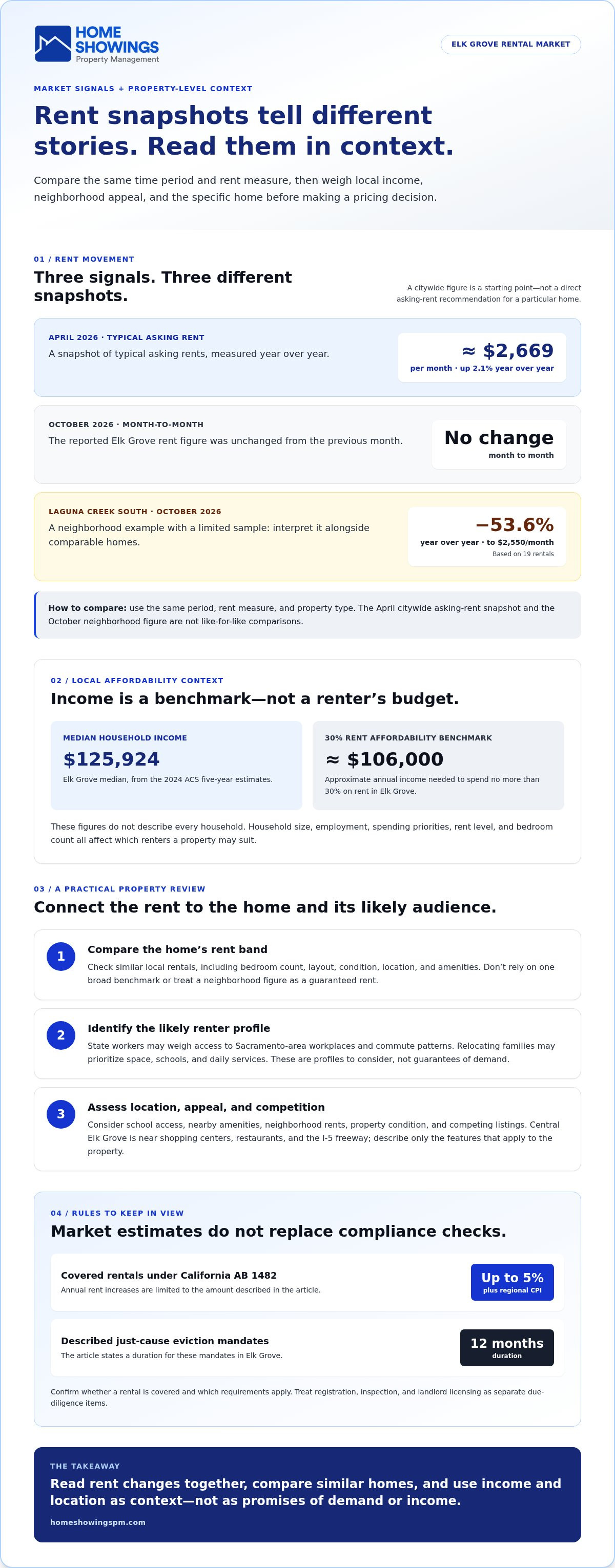
Elk Grove’s median household income was $125,924 in the 2024 ACS five-year estimates, according to the U.S. Census Bureau. That figure offers owners a local income benchmark, not a measure of what every renter earns. Households differ in size, employment, and spending priorities. Use it alongside the rent level and bedroom count when evaluating who a property may suit. An Elk Grove rental property market analysis is stronger when it connects income context with a specific home.
For affordability, renters would need to earn approximately $106,000 per year to spend no more than 30% of income on rent in Elk Grove. That benchmark helps frame the potential renter pool, but it doesn’t describe every household’s budget. Compare the rent and layout with the needs of the households you want to reach.
Employment context matters because income depends on more than a citywide median. State workers, for example, may weigh access to Sacramento-area workplaces and commute patterns when choosing a home. Relocating families may prioritize space, schools, and daily services. These are renter profiles to consider, not guarantees of demand. Identify the practical features that fit a property’s likely audience, then make them clear in the listing.
Rent levels also show why bedroom count matters when assessing affordability. These figures help owners compare rent bands across property sizes, but they don’t replace a property-specific review. Condition, location, layout, and competition all affect how renters judge value.
California’s AB 1482 allows annual rent increases of up to 5% plus regional CPI for covered rentals in Elk Grove. Elk Grove’s described just-cause eviction mandates have a 12-month duration. These rules make coverage and timing important parts of an owner’s rent and tenancy decisions. Keep the applicable limits in view when assessing future income, rather than treating a market rent estimate as permission to raise rent by that amount.
A practical review starts with three steps: compare the home’s rent band, identify its likely renter profile, and assess how employment access affects its appeal. Then consider whether the rent fits the space and the everyday needs the property serves. Household income provides context, while location and employment connections help explain why homes attract different audiences. Together, these factors support a more grounded rental strategy.
Neighborhoods with rental appeal
Neighborhood choice shapes who notices a rental and how its asking rent compares locally. In Elk Grove, weigh school access, nearby amenities, neighborhood rents, and the home’s condition together.
School and Neighborhood Appeal
Elk Grove’s school system serves kindergarten through 12th grade, a factor families may consider when comparing locations. Central Elk Grove is near shopping centers, restaurants, and the I-5 freeway, which can support convenient daily routines. When preparing a listing, describe the property’s actual location and nearby amenities clearly. Let the home’s features and setting reflect the renters it is best suited to serve.
Affordable Neighborhood Options
These examples help owners compare entry points across Elk Grove. They are neighborhood reference points, not automatic asking rents for every home. Compare the property’s size, condition, and location with nearby rentals before deciding where its price fits within the local range.
Neighborhood Rent Trends
Citywide patterns can hide sharp neighborhood changes. In Laguna Creek South, rents fell 53.6% year over year to $2,550 per month as of October 2026; the decrease applied to 19 rentals. That small set deserves careful interpretation beside a home’s specific features and competing listings. Check whether nearby examples share the same bedroom count, condition, and location before treating a neighborhood figure as a direct comparison.
For California rent limits and tenant protections, AB 1482 allows annual increases of up to 5% plus regional CPI for covered Elk Grove rentals, and the described just-cause eviction mandates have a 12-month duration. Treat registration, inspection, and landlord licensing as separate due-diligence items: identify applicable requirements, document property condition, and keep tenancy records organized.
No single lease-up timeline or vacancy rate applies to every Elk Grove listing. Time vacant depends on asking rent, property condition, season, location, and how closely the listing matches current renter needs. Compare competing homes with similar layouts and amenities, then monitor inquiries and viewings to see whether the listing reaches its intended audience.
Before buying, compare recent neighborhood rents with the home’s condition and likely maintenance needs. Review its inspection history, confirm which compliance obligations apply, and assess nearby listings for direct competition. For example, a home priced near Laguna Park’s neighborhood figure may need a different strategy if its layout or condition differs from nearby rentals. This keeps location data useful without treating it as a promise of income.
Year-over-year and month-to-month rent changes
Elk Grove’s rent picture depends on the date and measure: asking rents rose in one snapshot, while the later median declined slightly. Rental yields and cap rates require property-level calculations based on rent, vacancy, operating costs, and purchase price.
Rent Levels and Annual Growth
Typical asking rents were near $2,669 per month in April 2026, up 2.1% year over year. These figures describe different snapshots and measures, so they aren’t contradictory. For an annual rent-growth view, compare like with like: use the same period, rent measure, and property type before drawing conclusions.
Month to month, Elk Grove rents were unchanged as of October 2026, while the figure was $22 lower than the same time last year. Seasonality adds context: March rents are about 5.5% below the August peak season. Owners can use these patterns to plan listing timing, then compare current asking rents for homes with similar size and condition.
Median Gross Rent
A median reduces the influence of unusually high or low listings, but doesn’t show what a particular property can command. Compare the home with local rentals that match its layout, condition, and location.
Gross rent can include charges beyond base rent, depending on how a figure is defined. Keep comparisons consistent by distinguishing advertised rent from any included utilities or other charges. This makes a median more useful when evaluating expected rental income for a specific home.
Treat that figure as a broad comparison tool, not a standalone pricing formula. A smaller unit can have a higher per-square-foot figure but lower total rent. Compare both the total asking rent and the property’s usable space with similar local listings.
Single-family homes may attract renters seeking more space or a different layout, but the available figures don’t establish a fixed rent premium over other property types. Compare detached homes with similar properties, accounting for bedrooms, condition, location, and included features. This direct comparison is more useful than assuming a premium.
To estimate yield, compare expected rental income with the full acquisition cost and ongoing expenses. A cap rate is net operating income divided by purchase price; vacancy, maintenance, taxes, and insurance affect the result. No single yield or cap rate applies to every Elk Grove investment property.
Rental demand from state workers and relocating families
State workers and relocating families are two renter profiles owners can consider when positioning an Elk Grove home. Their needs differ: a state employee may prioritize commute logistics, while a relocating household may focus on space, schools, and move-in readiness. Treat these profiles as planning tools, not proof of demand. Evaluate each property’s features against the renters its location and layout can serve.
For a state worker, make practical details easy to assess in the listing. Describe the home’s location, parking, workspace options, and access to everyday services accurately. Avoid implying a commute time or workplace connection without evidence. Clear details help a household comparing Elk Grove with other places decide whether the rental fits its routine, especially when arranging a move before viewing the property in person.
Relocating families may compare bedroom layout, storage, school access, and nearby amenities. A home with separate living areas, for example, may suit a household needing space for work and family routines. Describe the property’s actual features rather than relying on broad claims such as “ideal for families.” Clear photos, accurate room descriptions, and straightforward application steps help prospective renters decide whether to schedule a viewing.
To assess demand, track each stage of leasing. Note how many inquiries become scheduled viewings, which questions recur, and whether applicants proceed after seeing the home. If prospects repeatedly ask about a home office, clarify the available space in the listing. If viewings don’t lead to applications, review rent, condition, and listing accuracy before changing the property’s positioning.
Seasonality can affect when workers or families plan a move, but the right timing depends on the property and its audience. Keep a record of inquiry patterns and vacancy periods for that home. Compare each new listing cycle with the previous one, including asking rent, marketing details, and viewing feedback. This creates a more useful demand picture than relying on broad assumptions about Elk Grove renters.
A practical positioning check has three parts: define the likely renter, identify the features that matter to them, and make those features prominent in the listing. For example, a home suited to a relocating family should clearly describe its bedroom arrangement and nearby services. For a state worker, emphasize accurate location details and practical amenities. Review inquiries and completed applications, then refine the listing based on observed responses.
A renter profile alone doesn’t establish demand. Compare actual prospect responses with the home’s condition, layout, and asking rent. When a listing attracts the intended audience but doesn’t convert, review the viewing experience and application process for friction. When interest is limited, reassess how the home is presented and whether its features match the renters most likely to consider that location.
Comparison with the national median
That places Elk Grove rents 39.5% higher than the national benchmark. The gap offers owners broad context, but it doesn’t establish the right rent for a particular home. Property type, location, condition, and included features shape how renters assess value within either market.
A national median combines rental markets with different costs, housing types, and local conditions. Use it to understand Elk Grove’s relative position, then turn to local comparisons for pricing decisions. For example, comparing a single-family home in Elk Grove with a smaller apartment elsewhere requires more than two median figures. Account for bedrooms, living space, property condition, and included amenities.
To compare Elk Grove with Sacramento and nearby cities, use the same method for each location: match property type, bedroom count, and rent measure. Compare similar homes and distinguish asking rents from medians. A citywide median can conceal differences between neighborhoods or housing types, so like-for-like comparisons offer more useful context. Check the dates too, since snapshots from different months may not describe the same conditions.
The 39.5% difference from the national median can help frame a renter’s budget conversation, but it shouldn’t be treated as a pricing formula. A higher local benchmark doesn’t mean every Elk Grove home supports a higher asking rent. Consider how the property’s condition, layout, and location compare with other rentals nearby. If a home offers fewer features than comparable listings, the national gap alone won’t explain its appeal.
Owners can apply this comparison in a practical sequence. First, record the home’s type, bedroom count, condition, and location. Then use the $1,900 national median as broader context, not as a substitute for local evidence. Keep each comparison tied to the same period and rent measure.
If a prospective renter questions an Elk Grove asking rent against a national figure, explain the difference between a broad benchmark and a local match. Show how the home compares with similar nearby rentals, including its layout and condition. This keeps the discussion focused on relevant alternatives rather than an average spanning different markets. Consistent comparisons also help owners avoid overreacting to national figures when reviewing local performance.
For an Elk Grove rental property market analysis, use the national median for perspective, then rely on local and property-level comparisons to guide decisions. Sacramento and nearby cities are useful reference points when property types, rent measures, and dates align. This disciplined approach helps owners evaluate a property’s position without assuming one citywide figure determines its rental value.
Home Showings Property Management: Property Management
Home Showings Property Management helps owners manage the rental process with Property Management, Rental Marketing, Tenant Screening, and Rent Collection. If local rent comparisons have clarified your property’s position but managing the next steps feels demanding, these services connect market decisions with practical leasing support.
Rental Marketing presents your property to prospective renters, while Tenant Screening supports applicant evaluation. Rent Collection handles incoming rent online through the tenant portal. Together, these services support an organized leasing process, from attracting interest to collecting rent.
Ready to discuss managing your Elk Grove rental? Contact Home Showings Property Management.
Put your rental plan into motion
A useful Elk Grove rental property market analysis should guide more than an initial rent decision. Turn what you’ve learned into an operating plan: define the renters your home suits, decide how you’ll measure listing response, and review results when tenant needs or property conditions change. This keeps your next steps tied to the home itself rather than broad market assumptions.
Home Showings Property Management can help put that plan into practice and align day-to-day rental operations with your ownership goals. Discuss your property and the support that would make managing it more straightforward.
Contact Home Showings Property Management to discuss your next step. A clear plan can help you move forward with greater confidence.
Frequently Asked Questions
What is the current average rent in Elk Grove, California, by bedroom count?
Use these figures for an initial comparison, then assess your home against similar nearby rentals. Differences in condition, layout, and included features can affect how renters judge its asking rent.
How have Elk Grove rents changed year over year and over the past five years?
Elk Grove rents decreased 0.8% year over year as of October 2026 and were unchanged month to month. Typical asking rents had been up 2.1% year over year in April 2026, illustrating how dates and rent measures affect comparisons. To assess a five-year change, compare the same rent measure and property type at both endpoints. Changes in the mix of listed homes can shift a citywide median without reflecting each home’s rent history.
Which Elk Grove neighborhoods have the strongest rental demand and highest rents?
Rental demand and highest rents aren’t interchangeable measures. Central Elk Grove’s access to shopping centers, restaurants, and the I-5 freeway may appeal to renters valuing convenience. To identify where demand is strongest for your property, compare inquiry and showing activity among similar nearby rentals. Then assess asking rents by bedroom count and condition. A neighborhood’s appeal depends on the renter’s priorities, so compare like homes rather than assuming one area leads across every measure.
What factors are driving rental demand in Elk Grove, including employment, schools, and population growth?
Employment access, household needs, school considerations, and population changes can all influence renter demand. State workers may weigh practical access to Sacramento-area workplaces, while relocating families may look for suitable space and nearby services. Elk Grove’s kindergarten-through-12th-grade school system is relevant to some households. Owners can connect these factors to a specific home by describing its location and layout accurately, then tracking which features prospective renters ask about during leasing.
What are typical rental yields and cap rates for Elk Grove investment properties?
Rental yields and cap rates require property-level calculations based on rent, vacancy, operating costs, and purchase price.



Comments