
Elk Grove landlord guide to fair housing laws

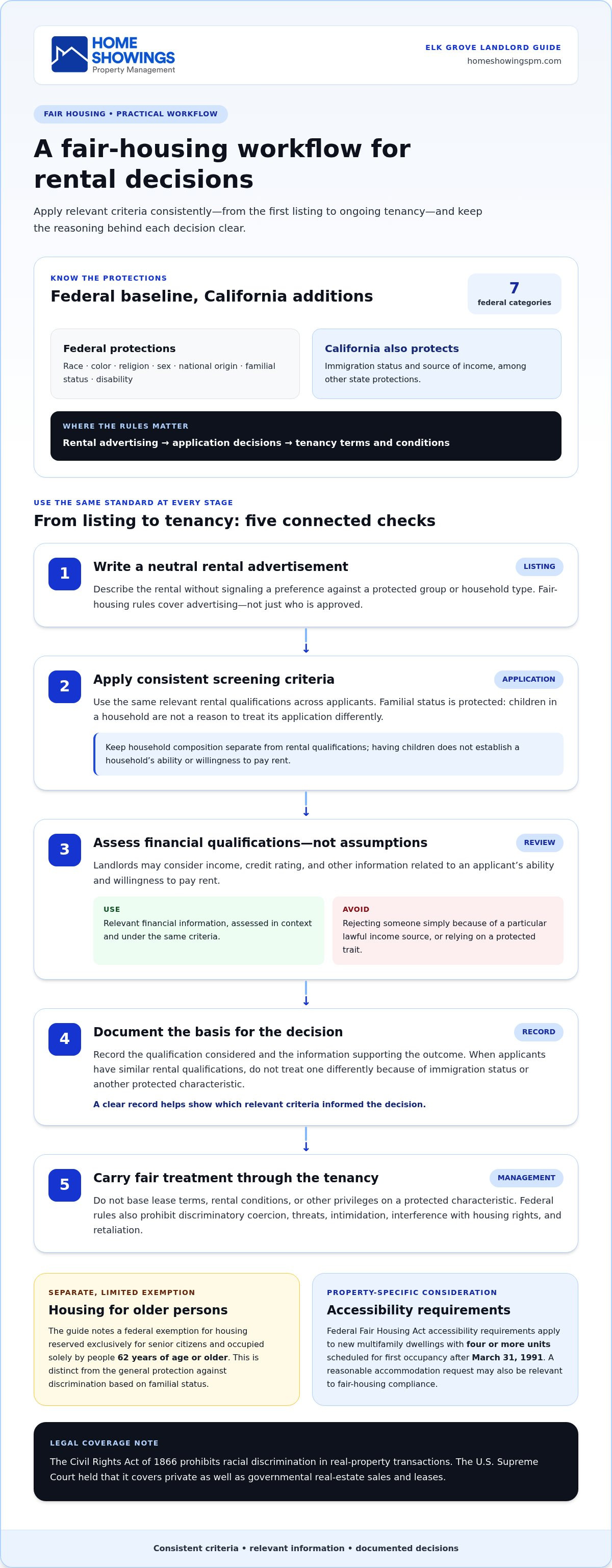
This Elk Grove landlord guide to fair housing laws starts with the core rule: federal law protects people from housing discrimination based on race, color, religion, sex, national origin, familial status, and disability. California also protects characteristics such as immigration status and source of income. These rules can shape rental advertising, application decisions, and how a tenancy is managed.
Knowing the protected groups is only the starting point. This guide explains what federal fair housing rules prohibit, when exemptions for certain housing intended for older people may apply, and how California protections extend beyond the federal baseline. It also shows how these rules relate to screening applicants and managing rentals in Elk Grove, so you can make decisions with a clearer understanding of your responsibilities.
Table of Contents
What are Protected Classes?
Protected classes are groups covered by laws against housing discrimination. An Elk Grove landlord guide to fair housing laws should explain how those protections apply to rental decisions. Federal law sets a baseline, while California also protects characteristics such as immigration status and source of income.
California Protected Characteristics
Federal fair housing protections cover race, color, religion, sex, national origin, familial status, and disability. California also protects characteristics such as immigration status and source of income. This broader scope matters because a housing decision may involve state protections even when no federal category is involved.
Use consistent rental criteria and document the information behind each decision. For example, if applicants have similar rental qualifications, don’t treat one differently because of immigration status. Base the decision on relevant rental information, not a protected characteristic.
Protected status does not prevent landlords from reviewing applications. Elk Grove housing providers may consider income, credit rating, or other information related to an applicant’s ability and willingness to pay rent. The reason for a decision matters: apply relevant criteria consistently, and never use a protected trait as the basis for different treatment.
Age and Familial Status
Familial-status protections address discrimination against families with children. Because federal fair housing law protects familial status, children in a household should not be a reason to treat its application differently from others.
Apply the same rental qualifications to a family with children as to another household, and avoid advertising that signals a preference against families. Exemptions for certain older-person housing are a separate issue discussed later in this guide, not a general reason to exclude families.
Keep household composition separate from rental qualifications in your records. Having children is not information about a household’s ability or willingness to pay rent. Documenting the criteria applied helps show what informed the decision.
Lawful Sources of Income
California protects source of income, so landlords should not reject an applicant simply because their income comes from a particular lawful source. During screening, assess relevant financial qualifications rather than making assumptions based on income type.
Compare applicants using the same rental criteria and evaluate their financial information in that context. Landlords may consider income, credit rating, or other information related to ability and willingness to pay rent. An income source itself should not replace that assessment or serve as a shortcut to rejection.
For Elk Grove landlords, a key takeaway from this guide to fair housing laws is to record the qualification considered and the information supporting the outcome. Separating income source from rental criteria helps distinguish a financial assessment from unequal treatment based on a protected characteristic.
What is Fair Housing?
Fair housing rules govern how landlords advertise, evaluate applications, and manage rental housing. A violation can lead to a complaint or legal claim, with potential damages and other remedies depending on the applicable law and proven facts.
Protection Against Racial Discrimination
The Civil Rights Act of 1866 prohibits racial discrimination in transactions involving real property, including rental housing. This matters because its protection applies beyond government-owned housing: the U.S. Supreme Court held that the law covers private as well as governmental real estate sales and leases.
Avoid race-based decisions throughout a tenancy, not just during application review. A rejection, lease term, or rental condition must not be based on race. Apply rental criteria consistently and keep records explaining decisions with relevant information.
Disability and Accessibility
Federal fair housing law prohibits discrimination based on disability, and accessibility rules apply to certain multifamily housing. Refusing a disabled tenant’s reasonable accommodation request is an example of conduct that may violate fair housing rules.
Construction requirements also matter for some properties. The federal Fair Housing Act’s accessibility requirements apply to new multifamily dwellings with four or more units scheduled for first occupancy after March 31, 1991. For landlords, this makes property type, unit count, and first-occupancy timing relevant when considering accessibility obligations.
State and Local Anti-Discrimination Laws
Federal rules are only one layer of the requirements landlords should consider. California protections cover additional characteristics, so a federal-only checklist can leave gaps in rental advertising and decision-making.
Elk Grove landlords should consider the rules relevant to the property’s location and the action involved. A rental advertisement, an application decision, and a tenancy condition can raise different compliance questions. Keep policies consistent, and ensure listing language does not signal a discriminatory preference. Landlords preparing listings may also consider rental marketing support as part of their rental operations.
Prohibited Practices in Renting
Fair housing rules prohibit discrimination in the terms, conditions, or privileges of renting a home. They also prohibit rental advertisements that indicate a discriminatory preference based on protected characteristics. For example, describing a rental as suitable only for a particular type of household may signal exclusion.
Restrictions extend beyond advertisements and applications. Federal fair housing rules prohibit coercion, threats, intimidation, and interference with housing rights for discriminatory reasons. They also prohibit retaliation against people or organizations that support fair housing rights. Review written communications and day-to-day decisions for these risks.
Public housing is also relevant to racial discrimination protections. The Civil Rights Act of 1866 applies to governmental transactions as well as private real estate transactions, according to the U.S. Supreme Court. This means public ownership alone does not remove racial discrimination protections from housing transactions.
Federal Fair Housing Act protections
The federal Fair Housing Act bars discrimination in housing transactions based on specified protected characteristics. For Elk Grove landlords, it applies to rental decisions and advertising, while disability protections also affect certain accessibility matters.
The Act prohibits discrimination based on race, color, religion, sex, national origin, familial status, or disability. These protections apply to the sale, rental, and financing of real estate. A landlord’s process should not use a protected characteristic to decide who may apply, rent, or receive particular terms.
Federal fair housing protections extend beyond the final approval decision. Rental advertisements cannot indicate a discriminatory preference based on race, color, religion, national origin, familial status, or disability. Listing language can signal exclusion before an applicant contacts the landlord, so review descriptions for wording that favors or discourages a protected group.
The law also covers conduct that interferes with housing rights. Coercion, threats, intimidation, and discriminatory interference are prohibited, as is retaliation against people or organizations supporting fair housing rights. For example, a landlord should not threaten an applicant for raising a discrimination concern or helping someone exercise housing rights.
Disability protections include reasonable accommodations. Refusing a disabled tenant’s request for a reasonable accommodation to their unit is an example of a fair housing violation. The 1988 amendments to the federal Fair Housing Act took effect on March 13, 1989, and added protections relating to people with disabilities.
Accessibility requirements also apply to specific new multifamily housing. The federal Fair Housing Act’s accessibility requirements apply to new multifamily dwellings with four or more units scheduled for first occupancy after March 31, 1991. Unit count and first-occupancy timing are therefore relevant when considering whether those construction requirements apply.
Federal law includes limited exemptions, and their conditions matter. Exemptions include owner-occupied buildings with four or fewer units and single-family housing rented without a broker. Certain housing operated by religious organizations and private clubs is also exempt when occupancy is limited to members.
These exemptions are specific, not a general waiver for landlords. Ownership, rental arrangements, use of a broker, and occupancy limits can determine whether an exemption applies. If a rental does not meet the stated conditions, do not assume it is exempt. Treat federal protections as the baseline and consider California requirements as well.
The federal Fair Housing Act was created in 1968 and included in Title VIII of the Civil Rights Act. Its practical reach spans advertising, rental terms, application decisions, disability accommodations, and certain property-accessibility requirements. Reviewing each part of the rental process helps landlords identify where protected rights may be affected.
Housing for older persons exemptions
Federal law provides specific exemptions for qualifying housing for older people. The stated age thresholds and occupancy descriptions matter: an age-focused name alone does not establish that an exemption applies.
According to the U.S. Department of Housing and Urban Development, federal Fair Housing laws exempt housing reserved exclusively for senior citizens and occupied solely by people 62 years of age or older. The description includes both exclusive reservation and actual occupancy. Landlords evaluating this category should distinguish the housing’s intended audience from who occupies it.
A separate federal exemption concerns housing intended and operated for people over the age of 55, according to the U.S. Department of Housing and Urban Development. The description combines two features: the housing is intended for that age group, and it is operated for that group. These words identify the relevant features without treating an advertising phrase as a complete explanation.
The two descriptions should not be collapsed into one rule. One refers to housing reserved exclusively for senior citizens and occupied solely by people 62 years of age or older. The other describes housing intended and operated for people over the age of 55. A landlord considering an exemption should identify which description is relevant before making decisions about rental policies.
For a practical review, organize the information around the stated criteria. Record how the housing is described, whether it is reserved exclusively for senior citizens, and who occupies it. For the 55-and-older description, note the intended audience and how the housing is operated. These details help keep the review tied to the exemption’s wording.
Keep exemption analysis separate from ordinary applicant screening. An age-related exemption does not automatically change every other fair housing obligation. The exemptions apply to particular types of older-person housing; they do not mean that all rental decisions or advertising practices are exempt.
Elk Grove landlords can use this distinction when reviewing a property’s policies and communications. If a community is intended for older residents, compare its actual operation with the applicable federal description. If its age-related language is unclear, revise internal records and rental materials so they accurately describe the housing arrangement.
Careful documentation also helps maintain consistency over time. If occupancy or operations change, update the property’s records to reflect those changes. Keep the 62-year and over description distinct from the description for people over 55, and avoid treating either threshold as a blanket exemption for unrelated conduct.
State-specific landlord-tenant laws
California protections shape everyday rental decisions in Elk Grove, including how landlords assess applicants. For screening, separate relevant rental information from protected characteristics.
California landlords may consider income, credit rating, or other information related to an applicant’s ability and willingness to pay rent. Decisions must not discriminate based on protected characteristics. Apply screening criteria consistently and assess whether each record relates to the rental decision rather than serving as a proxy for protected status.
When considering criminal, credit, income, or eviction history, use information consistently and assess its relevance to the tenancy. Income, credit rating, and other information connected to ability and willingness to pay rent may support a denial. Do not treat a record as an automatic substitute for an individualized, rental-related assessment.
California protections include characteristics such as immigration status and lawful source of income. Screening procedures and rental communications should therefore account for more than the federal protected categories. An applicant’s lawful income source, for example, should not by itself determine whether an application is accepted or rejected.
A consistent process starts with written criteria. Set rental qualifications before reviewing applications, then apply the same criteria to each applicant. Record the information considered and the reason for the outcome. If a decision relies on credit or income, document how that information relates to the applicant’s ability and willingness to pay rent.
Consistency matters even when applicants provide different types of information. One applicant may provide employment income records, while another relies on a different lawful source. Assess relevant financial information using the same rental standards, rather than assuming one source is less dependable because of its type.
California landlords should consider state and federal requirements together. Federal fair housing protections establish a baseline, while California recognizes additional protected characteristics. A policy covering only federal categories may overlook state protections relevant to advertising, application review, or tenancy decisions.
For a practical review, examine rental advertisements, screening standards, and decision records as connected parts of the process. A listing that discourages a protected group can create a concern before screening begins. Written decision records can help show which rental-related criteria informed the outcome.
Landlords can organize applicant review with tenant screening support that keeps rental criteria and records together.
Landlords can visit the U.S Department of Housing and Urban Development website for an exact copy of their state's fair housing and anti-discrimination laws. New York State law prohibits discrimination in publicly assisted housing based on race, religion, color, national origin, or ancestry (Article 2-A, §§18-19).
Home Showings Property Management: Property Management
Home Showings Property Management provides residential property management for owners who need support coordinating rental operations. Its rental marketing and tenant screening services help manage those parts of the process, while consistent fair housing practices remain essential.
Consistent processes matter from listing through tenancy. Home Showings Property Management also provides rent collection as part of its property management services, helping owners coordinate key rental tasks. Landlords remain responsible for making decisions that comply with fair housing rules, so clear criteria and careful records still matter.
Contact Home Showings Property Management to discuss property management for your rental.
Make fair housing part of your rental routine
Turn your policies into a repeatable process that supports careful decisions throughout a tenancy. Clear documentation helps keep advertising, application reviews, and communications organized. Regularly reviewing those records can also help reveal inconsistent practices before they become routine.
Use the Elk Grove landlord guide to fair housing laws as a starting point for those routines, then keep your records aligned with how you actually manage each rental. If you want help coordinating rental operations, Home Showings Property Management can be a resource for your next step.
Contact Home Showings Property Management to discuss your rental needs. A consistent approach can make day-to-day decisions easier to manage and help you move forward with greater clarity.
Frequently Asked Questions
What are landlords' reasonable accommodation and modification duties for tenants with disabilities in California?
Take disability-related accommodation requests seriously. Refusing a disabled tenant’s reasonable accommodation to their unit can violate fair housing rules. For example, a tenant may request a change related to using the rental home. Record the request, decision, and rationale. Consider each request individually rather than rejecting it automatically because it differs from a standard policy.
What are the fair housing rules for rental ads, tenant screening, and application decisions in California?
California rental advertisements and application decisions must not discriminate based on protected characteristics. Avoid listing language that signals a preference against a protected group. For screening, consistently apply rental-related criteria, such as income, credit rating, or other information about ability and willingness to pay rent. In Elk Grove, documenting the criteria behind each decision helps show that applicants were assessed using the same process.
What are California landlords' obligations regarding service animals and emotional support animals?
Requests involving service animals or emotional support animals can raise disability-related accommodation issues under fair housing rules. Federal protections cover disability, and refusing a disabled tenant’s reasonable accommodation can violate those rules. Consider the accommodation requested rather than treating an animal label alone as decisive. Record the request, response, and reasons for the decision.
What fair housing rules apply to families with children, occupancy limits, and adults-only rentals?
Familial-status protections mean landlords should not exclude applicants simply because their household includes children. Apply rental criteria consistently and avoid advertising that suggests families are not welcome. An adults-only policy may raise fair housing concerns. Federal exemptions for certain older-person housing depend on the applicable age and occupancy description, so assess occupancy policies individually rather than assuming an adults-only preference is exempt.



Comments